
Listen free on any device:
Link:https://soundcloud.com/astrophiz/astronomy-astrophiz228-dr
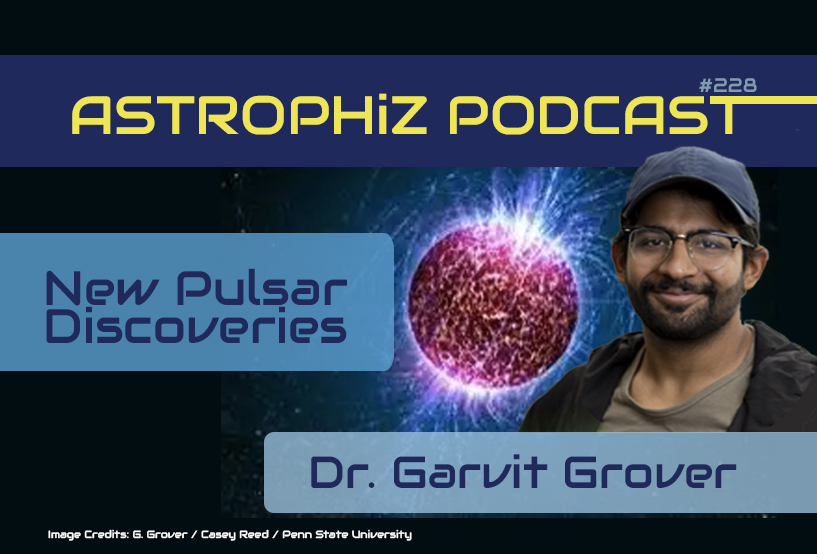
“Dr Garvit Grover lifts the lid on misbehaving pulsars.”
A fantastic interview with an amazing pulsar astrophysicist who is unraveling the secrets of nulling pulsars and ‘death lines’ using his phenomenal coding skills.
TRANSCRIPT:
Brendan: Welcome to the Astrophiz podcasts.
My name is Brendan O ‘Brien and we’d like to acknowledge Australia’s first astronomers, the Aboriginal and Torres Strait Islander people, the traditional owners and custodians of the land we are on. This episode is produced on Yorta Yorta and Pangarang country in the East and WhadjukNoongar Country in Perth….
And we’re also asking you to influence your local politicians with a message that we really need to change our energy policies and move to renewable energy sources to mitigate the effects of climate change.
Each month, we love bringing you two fabulous episodes … on the first of each month, our friend molecular pharmacologist, toxicologist, and amateur astronomer, Dr. Ian ‘Astroblog’ Musgrave, brings you his monthly SkyGuide with all the essential observational highlights for telescopers, photographers and naked eye observers.
Then, later each month, we bring you an exclusive and in-depth interview with a noted astrophysicist, astronomer, particle physicist, radio telescope engineer, data scientist or space scientist. And we discover their science journey and rare insights into how they think, when they think best, and how they conduct their amazing research into exactly how our universe works.
Our audio files and transcripts are available on our website at astrophizDOTcom and our MP3 files can be freely streamed or downloaded to your favorite device from our SoundCloud channel, our free Amazon Audible stream, YouTube podcasts, Spotify, Podbean and Apple Podcasts.
But right now, we’re zooming over to Perth to speak with an incredibly talented researcher, a wonderful young scientist, Dr Grover. You’ll love his stories.
Brendan: Hello, Garvit.
Garvit: Hi, Brendan.
Brendan: Today, listeners, we’re lucky enough to be speaking with Dr. Garvit Grover, who is a Pulsar researcher after being awarded his PhD in astrophysics at Curtin University in Perth, Western Australia. He has recently discovered a unique class of Pulsar using the SKA Pathfinder at the Murchison Widefield Array in the remote outback scrublands of Western Australia.
So, congratulations on your discovery, and thanks for speaking with us today, Garvit.
Garvit: Thank you, Brendan. It’s a nice opportunity to be able to talk about research.
Brendan: Excellent. Thank you. So, before we talk about your Pulsar discovery, can you tell us where you grew up, please, Garvit, and could you tell us how you first became interested in science and space?
Garvit: Sure. So I grew up and I was born in New Delhi, in India, and we moved over to South Australia, somewhere around 2008. And from that, I came to Perth and around 2014. And onto the topic of the science, well, to be honest, I watched a lot of YouTube videos growing up and watching channels like SciShow and Kurzgesagt … Those kind of shows inspired me and got me interested in space overall. So that’s where it kind of grew.
Brendan: Terrific … okay. Now, what about those school days? Your move to Australia and those earliest ambitions that you had, did those early ambitions change and evolve over time?
Garvit: Oh, definitely. Now, I did want to be interested in science from a very young age, so I knew I wanted to kind of go in that field, but remember in high school, I was very adamant on being a software developer, and I was inspired by my cousin’s wife, who was also developing code for ATM machines. I thought it would be such a cool thing to see your code being applied to real-life things. However, I’d had a poor experience with a poor teacher in high school, late stages.
I had a teacher who had done physics. They kind of inspired me to be like, yeah, you know what, this would be a cool, different pathway that I could follow.
And I didn’t really think too deep about what kind of job I would be doing or how it was going in the long run. I just thought … ‘this is interesting, this is fun, and I feel like I should be using my capabilities for something that I like’ … and here we are.
Brendan: Thank you, Garvit. So, after school, you were awarded your first class honours Bachelor of Science degree in Physics and Astronomy at Curtin University in Western Australia. Then you stayed on a curtain for your PhD.
Now, for our early career researchers listening and perhaps undergraduate students … Could you tell us how you arranged that move from undergrad to PhD, and why you chose such a difficult post-grad study trajectory for your PhD?
Garvit: Yeah, it was difficult indeed.
I personally think that it was difficult. Going into physics is already a difficult thing. So I feel like going further into the PhD wasn’t much of a difficult to ask, if anything, it was more enjoyable.
But to begin, so when I was an undergrad, I was very connected with the third years because they were … they were the people who kind of mentored us when we first came. And so we kept in touch a lot between classes. And as they grew up to do PhDs, we still kept in touch with them. And we kind of understood how the layout works.
We kept in touch with the researchers at the institute.
We were involved in the talks and whatnot. So even from undergrad, we had a good idea of how a PhD would look like … and if you wanted to follow that path or not,
I had some friends who weren’t able to follow PhD because they had some different requirements or different needs. Whereas I had a fair few people who did want to continue a PhD with me.
So in a way, it was comforting having a group of people doing it with you, making that transition with you. But yeah, I would say having that backing from the older students, that transition was so much easier. And I chose to stay at Curtin because in my late undergrad, there is a requirement at Curtin to do some research. And with that research that I did with the supervisors … I figured out that I like those supervisors a lot.
That’s one of the things I feel like it’s key for research, no matter what your topic is, as long as you work well with the supervisors.
Brendan: Okay. Talking about supervisors, would you like to mention some of the people who have inspired and supported your science journey and perhaps some of the people you’re working with right now on your research.
Garvit: Yeah, so like I mentioned, my supervisors took a great deal of interest in helping me get to that stage of a research at PhD.
My supervisor who I talked to the most, who had an interesting journey where they did a Bachelor’s in Music first and then decided later in their life that they want to do physics. So being an older person that all eight years of physics and did research, that definitely was inspiring to me to feel like I can change whatever career I want. I should just do what I like.
Brendan: Yep. All right. Yeah. Look, let’s get on to some science now.
Pulsars 101. Could you take us through that in a nutshell, tell our listeners what pulsars are, what different types of pulsars there are, what are their main characteristics and what’s the most common type of pulsar and do they have a life cycle and what happens at the end of their life and how do you detect pulsars?
And last and the most important question, Garvit, is why do you love Pulsar so much?
Garvit: Excellent. So a quick Pulsar 101 is … pulsars are neutron stars that are remnants of giant stars. So when giant stars explode from supernovas, they leave behind a small neutron star, which has a very strong magnetic field.
And naturally, these neutron stars spin very, very fast. And this fast spinning and strong magnetic fields emit very strong radio waves from their magnetic poles. And since the magnetic field and the rotational axis of the neutron stars are misaligned, they kind of spin … like lighthouses in the sky.
And so what you would see is, if you’re looking at them, is a little blip every rotation because the radio waves are passing by us. So that’s why they’re called pulsars because they look like pulsating stars when really they’re just rotating. They start out being very erratic, having been transformed from a giant star exploding to a small neutron star. So they’re very energetic, and they’re very erratic in how they behave, so they haven’t calmed down yet.
When they calm down, they’re more stable, and what we call canonical pulsars … pulsars that are boring. They spin about once every second. They don’t have very strong magnetic fuels. They just have, they’re in this kind of stable state.
However, later on, they kind of slow down. And once they slow down enough, they believe that they don’t have enough energy to be able to produce waves.
So they’re kind of in this graveyard called ‘The Death’.
So once they get old enough, they kind of cross this imaginary line called the ‘death lines.’ And after those, we believe that such pulsars can’t produce any more radio waves, hence they are dead.
But if they’re in a, what you call a binary system, sometimes they can gain mass from their companion, and that can restart them up. To the point where they become so fast … They’re spinning at about once every millisecond rather than once every second.
Brendan: Cool.
Garvit: That kind of can be a life cycle of a typical pulsar.
Brendan: Nice.
Garvit: Yeah. So these pulsars are very bright in is the radio spectrum.
And so you would use radio telescopes to detect pulsars. However, there are a few ways you can detect them. So since pulsars spin periodically you can use some periodic searches such as a Fourier Transform search … or you can simply fold some bits of time together to find the period of the pulsar and when you do that you’re adding their signal up from each rotation so that makes it easier to find them in the sky … or you can use what’s called a single pulse search where if the single pulse is bright enough, you can take the pulsar based on that bright single pulse.
Brendan: Beautiful. And our final question of Pulsars 101 … Garvit is … why do you love pulsars so much?
Garvit: Yeah. So personally, I find that most astronomy deals with images, making images, looking at the sky … and a lot of people that I’ve been around to kind of do that whereas in pulsars it is a bit different. It’s just signals and I feel like it’s simpler, but also you can do so much mathematically with them and that kind of relates also to other real world aspects.
So if I wanted to do some pulsar research and I’m happy with it and I move on, I feel like I can move on to a lot of other things, because signals are such a cool part of what technology is.
Brendan: Fantastic! Pulsars are very cool! OK … Now could we have a quick look at your PhD research to help us understand your personal research trajectory?
Your thesis, that you’ve just been awarded your PhD for … the title is: ’ Exploring long- period and nulling pulsars near the death-lines’. Now, you explained death lines just previously. Perhaps you could tell us what ‘nulling pulsars’ are … and what are ‘death-lines? Perhaps you could tell us what nulling pulsars are and perhaps a bit more about death lines. It sounds a little bit nasty and also it sounds a little bit sad. Tell us about nulling pulsars and death lines please …
Garvit: Sure … so i’ll just revisit about the pulsar life cycle real quickly … so just a reminder … pulsars themselves are kind of … the zombies of normal stars right … to normal stars die from explosion and you get kind of this pulsar … and now when pulsars die … or when we think they die … we believe that they get too slow in their rotation to be able to produce this energy.
And we don’t really exactly know where this cut-off is, that they die, what the fine line is, but based on the discoveries of pulsars there are, people have formulated a really complex theories on where this could be.
And this cut-off is what we call ‘death lines.’
And as you may know, and as you can assume, since there isn’t one correct answer, there are multiple death lines … that have different answers.
And we call that area ‘the death valley’.
Now, nulling pulsars are these objects that do not continuously emit radio emission.
So … most pulsars continuously emit radio emission, whereas nulling pulsars, they are sporadic.
So sometimes they turn off and turn on. And this can be a systematic thing. And some pulsars are very erratic. So it can change. Most people thought that it was a very erratic thing, but recently we may think it could be more systematic than we think.
Brendan: Okay, so not so nasty at all … but yeah. Okay, let’s get back to your thesis. Now, what big questions were you asking and what problems were you working on that you had to overcome to complete your thesis?
Garvit: Sure. So this field that I was working on is the fact that recently there have been a few long period pulsars that sit on the very edges of death lines.
Previously, we thought death lines mean that pulsars shouldn’t be able to be found near the edge of them or beyond them, but recently we’ve found a fair few long period pulsars lying on the edge of those death lines.
So we may think that our theories aren’t really 100 % all the way there when we come to death lines.
Additionally, these pulsars that are very long period also show nulling.
So that kind of naturally leads to the conclusion that nulling could be related to death lines.
And even if you look at nulling in general, you can make the connection that, okay, a pulsar temporarily turning off is similar to pulsar turning off entirely.
So the big problems that I was facing was the fact that there was such a small sample that I couldn’t really focus on. I couldn’t make any big conclusions from a small sample. So I had to work around that a bit. I had to learn completely new skills in terms of coding and supercomputers.
That was a bit of an issue. And I would say probably the biggest issue for me to overcome was learning a lot of stats and using complex statistics to be able to make valid conclusions.
Brendan: Excellent. Thank you. I should have congratulated you on your PhD thesis. It’s a great achievement to ride that PhD roller coaster and get to the other end.
I am very envious. Wonderful! Love it!
So we’re up to date now and perhaps we can now have a look at the very latest technologies and techniques that you’re using to understand some of those mysteries associated with pulsars, and what is exciting for pulsar scientists right now.
So what are your favorite research instruments or observatories and what’s the buzz with pulsars? What’s going on?
Garvit: Awesome. Great question.
So I would say two of the most exciting machines right now, personally in the radio observatory field, for me, is the FAST telescope in China and the MeerKAT telescope in South Africa.
So the FAST telescope is a huge dish that they’ve made. It’s got an aperture of 500 meters. So it’s very, very big. They’ve dug out a mountain, a valley, sorry, and made this big, what looks like a big roller skating rink. It’s a huge dish that they use to look at the sky. And it is the most sensitive machine we have so far. And how that’s helped pulsars is the fact that since it’s so sensitive, It has found some of the faintest objects out there.
And personally, for me, in the world of nulling pulsars, it has been able to look at the nulling portions of pulsars where we thought they were turning off. It has found small, very faint bits of emission.
So that has been very interesting … and in terms of MeerKAT, it is a precursor to the SKA. So it is using these new technologies, this new algorithm, and it’s huge. And what it’s been able to do is just be better than almost every telescope out there. It’s more sensitive, not as sensitive or as fast, but it’s still pretty sensitive.
It’s pretty fast in processing. It can look at more of the sky. It can just churn out so many great results. And that’s just amazing.
Brendan: It is amazing, and I’ve heard mention many times that we are in a golden age of astronomy.
Now, I did a search on the ArXiv server, and I found one of your most recent papers where your team have developed that new way of overcoming noise in the data from Pulsars.
Now, we do know that noise in the signal -to -noise ratio is the enemy of all astrophysicists, and most likely you especially, and your mathematical solution looks incredibly complex to the layman like me…. but how would you describe your new technique that you and Brad Myers and your team have developed to overcome that noise problem?
And more importantly, for our listeners …How would you describe this solution to the general public?
Garvit: Great. So the telescope that I use a lot with my team is called the MWA. Sadly, unlike these great telescopes that I recently mentioned, the MWA does not have a great sensitivity. So it has to make do with what it has.
So one of the things that comes with it is our struggle to overcome the signal -to -noise ratio, right?
We’ve got to have a good enough signal-to-noise to be able to do sine. So the issue that I was having is that some pulsars look like they’re nulling, but it also could be that the emission that they’re producing is just so faint that you can’t distinguish the nulling from the pulsar actually emitting.
So how do you overcome that? So I use the technique of how pulsars are found.
Pulsars are found by kind of guessing what their period is, and you add the radio emission from their period. So I use this technique of how pulsars are found.
So the way you would find a pulsar is you look in a direction, and it gives you radio emission, but then you guess where the period is. You have a whole bunch of periods you kind of churn through, and if you get the good right period, then the emission will stack on top of itself to produce a raw signal-to-noise ratio.
So you’re adding the emission to increase the frequency.
Now, how I use that is, in a given observation, most people, what they would do is to look at nulling. They would use individual pulses to distinguish nulling and distinguish what the pulse is actually emitting.
What I did was I used multiple pulses and I predicted that if there was one or two pulses in there and a single null, what’s the probability that the sum would have this value?
So having that mindset, I could guess the range of values that the different sums could have And mathematically, knowing the different probabilities of the different outcomes, I could make a graph of the different sums and how they would look.
So once I have the theoretical bit there, I can then use the actual pulsar, make the different sums, and see how it looks like. And based on how it looks like,
I can reverse engineer the probability of the pulsar are nulling. Does that make sense? It’s a bit too complicated still?
Brendan: That is fantastic. No, that’s beautiful. It’s great. You start off with a guess and you verify the accuracy of your guess and then you compare that with what you actually see and you are verifying your observations and coming up with that new data that you wanted. Fantastic. Thank you.
So what happens when a new technology like this is developed?
Your papers are freely available on the popular ArXiv server, but how do you spread the word when new discoveries are made in your astro community?
Garvit: Great. So yes, as you mentioned, they are freely available on archive. But what usually happens, at least with my scientific institution, is that we aim to publish our results to a journal. And so what happens is we get a journal that we think would be appropriate for the work we’ve done. So our work, we went to the Astrophysical Journal. And what they do is they have people who are volunteers and they review your work.
Because with any new technology, any new methodology, you have to have some peers comparing and checking your work to ensure that you haven’t, or your group hasn’t made a silly mistake, and your whole work isn’t just invalid.
So once it goes through that process and they have validated your work, what happens is then they will process the report for publication, and while that’s happening, we put the work that we have done on ArXiv.
So now it’s peer -reviewed work that is freely available.
It’s not polished and it’s not published yet.
That will happen through the journal.
But it’s available so people can read it and look at it.
Now, sadly, my work isn’t that groundbreaking. But what happens is when you do have a new result, a huge result, a good image or a new object, there is a media release.
You would, like I’m doing an interview with you, people would do an interview with ABC, for example. They would do articles that would spread on social media and all that.
Brendan: Thanks, Garvit. Now, we know very well that science doesn’t always sail smoothly, and we’re very happy to keep our propeller heads on for a while. Could you share with us some details of a particular part of your research that once drove you crazy or was astonishingly exciting. Well, perhaps it was both.
Garvit: Yeah, perfect. So one of the biggest projects that I’ve done in my PhD is doing a simulation. So like I mentioned before, that since there were so few of these objects that I was interested in, I couldn’t really do much work with the ones that existed to make big conclusions.
So an idea that I had with my supervisors was how about we simulate some of them and we figure out what technique can be best for finding more of these objects. And so the simulation was very big work. I was not very confident in my coding skills, but luckily I had some help.
So I made this huge code in Python and what my supervisor did was “Great! That’s good code! … but now let me do it better” … so he translated all my code into CUDA … which is a language that’s used for paralleling with GPUs so you can make it a lot faster.
That was great … but the weird part was I would run it and it would take so long for it to run took me many months just to run it I realised that I had one tiny mistake in there or something was wrong, and I would have to scrub all of it and do it all over again, and just that time-consuming … it just drove me nuts.
So the first part was great, but then when I submitted to the journal, the referee pointed something out that seemed odd. And I was “Great, let’s follow up on it.”
… and that following up alone then took almost six months of reprocessing, rewriting, doing all the work again, and then submitting a back to the journal.
So that time was just excruciating to spend on small problems.
Brendan: Oh, yes, well, we did talk about it being a roller coaster. Thank you, Garvit. Now, as a pulsar researcher, you’re also immersed in solving some of the most complex and puzzling phenomena in our universe and to boost morale among your fellow PhD students, you championed your “break bell”, ringing this bell at 10 a.m. and 3 p .m. each day to encourage coffee, conversation and a well-deserved pause … which suggests to me you’ve found more than one solution to my next question.
How do you do your best thinking? What circumstances do you usually need to swim clearly through that huge sea of MWA data and come up with those verifiable conclusions? What situations and surroundings support your best thinking, Garvit?
Garvit So I’m glad you mentioned the ‘break bell’. So I am a huge champion for procrastination. Now, that might sound like not the most productive thing, but I feel like I could not be sitting there for hours and then doing the same thing. I need something different. I need something new. I need to get up from my seat and do something. So the break bell was a great idea that was supported by my fellow PhD colleagues.
So at 10am, you’ll just have a coffee … and at 3 pm. you’ll spend a good half an hour just sitting outside, chatting, doing whatever, and then going to go back to it. Now, that’s kind of what I feel like needs to happen for your brain to kind of rewire, rethink, and explore new ideas.
Now, in one of my research projects, it’s based on me finding a new pulsar. Now that’s exciting, but that was purely because of me procrastinating. I did not want to do the work that I was doing. I was working on the simulation. I did not want to do that work.
And what I ended up doing was I just ended up scrolling through some data. I just feel like, I don’t want to do my work. Let me just do this for fun. And through scrolling of that data, I found new pulsar.
Brendan: Beautiful! Highly organised serendipity Thank you, Garvit. Now, I just had a quick look at your CV, and I noticed you were finishing off your Bachelor’s degree in Physics and Astronomy back in 2020/2021, just when COVID hit, and the West Australian borders were closed right through until March 2022.
Now, how did COVID affect you, your exams, your family and what was the impact on your astrophysics research were there lessons learnt?
Garvit: Yeah definitely now we’ll say being in Western Australia …we were very fortunate that there weren’t many lockdowns … so there was initially a bit of confusion as to what and how things were going to run and we did do online classes for a bit … but seeing as things were very calm in Western Australia, we were able to quickly, we’ll go back into university and considering physics is not a huge field, we were able to go around some restrictions by having small groups or small classes still running.
So it was a bit of impact, but it wasn’t huge. On the research side, it did bring around the idea of you need to be able to have your research organised so that you can still work from home … you can work while you’re there you need to have access to your data it needs to be backed up all these little things that normally you wouldn’t have to worry about.
I know it was a big thing and that has continued throughout most people’s research is having that safety.
Brendan: Excellent … and that is an excellent outcome Okay, now to sum up, You’ve painted the big picture of pulsars, we’ve done Pulsars 101, we’ve looked at your early research, we’ve gone all sciencey.
Would you like to tell us about some of the things outside your research that regularly brings you great joy?
Garvit: Yeah, that’s perfect. So one of the things actually … going back to the 3pm Bell, one of the things someone suggested was bringing a table tennis table.
That kind of shifted the whole culture of the workplace was that everyone wanted to be on the table tennis table.
So having a sport that I don’t really think I would enjoy that much, it was so fun getting into table tennis. I was watching videos. I was learning all the small techniques and I just appreciate the a little bit more. Yeah, I feel like just group sports that are not very physically aggressive, but require just technique.
I had a great appreciation through that table tennis phase.
Brendan: Beautiful. That’s fantastic. Thank you. Now, you’ve done some teaching. You’ve done demonstrating and mentoring of undergraduate students, and you’ve given a wide variety of talks and presentations, you’re doing outreach right now.
Is outreach an important part of being an astrophysicist?
Garvit: Absolutely. Sadly, the meaner about science is that ‘science is for smart people. Science is scary. Science requires you to be a young Albert Einstein’.
But sadly, that is not true.
Science is a very collaborative thing. ‘The more the merrier’ is just the layout of how science works. And I feel like outreach is the best way to show people that. It’s the best way to excite people about science, best way to share research, share knowledge.
The core foundation of what science is … is sharing.
Brendan: Thank you very much, Garvit. Now, finally, the microphone is all yours and you have the opportunity to give us your favourite rant or rave about one of the challenges that we face in science, in equity, in representations of diversity, or in science denialism, or science career paths, or your very own passion for research, or our big human quest for new knowledge.
The microphone is all yours, Garvit.
Garvit: Right. So one of the things I would like to cover is the diversity in specifically science and astronomy.
So I was a part of a development community for most of my PhD. Now this community focused on culture, diversity, inclusion, and how we can support that in the workplace.
And I found that there is a lot of support for diversity and inclusion in science … however that’s more of a personal experience … I found … I am aware that there is a huge blockade that has to be overcome for some of the older generation … I found that specifically women … and for people facing diversity issues … there is still a lot there … but I would say from a personal experience and from being at Curtin, it’s very inclusive.
I would encourage people to get involved in science because science is the most inclusive workplace. Having said that, there are challenges. One of the main things we did focus on in that committee was trying to get more people, get more women, get more people of diversity, get more people with different social orientations to come in because we want everyone.
So if I was to rant about something … is … not enough people are doing science, all kinds.
Brendan: I couldn’t agree with you more. We need to have as many voices and as many cultures and ages and attitudes … the whole gamut.
Thank you, Garvit. Now, is there anything else we should watch out for in the near future? What are you keeping your eye on?
Garvit: So here’s a little thing about a small telescope called the SKA.
Brendan: Heh heh!
Garvit: Of course I’m joking… because the SKA is probably the biggest telescope that will be in the next 50 years.
So for those who don’t know, the SKA is a telescope that is internationally funded, but it’s split between South Africa and West Australia, and this telescope is set to break all the records … solve a lot of the problems in science.
It’s meant to be kind of the Holy Grail, and I’m very much looking forward to be able to work on it, to be able to work with it.
That’s just something I am personally focusing on, and hopefully I can get a job out of that. That would be ideal. But for those who I’m interested in science. This telescope will be the one in the next 10 years. Once it’s all done and ready, it will be making some headlines. So have a look at for that one.
Brendan: Well, I for one am looking forward to seeing you working with the SKA. Fantastic Garvit. Well, thank you so much, Dr Garvit Grover. On behalf of all our listeners, and especially from me, I’ve learned so much about pulsars. Been really exciting to be speaking with you.
Congratulations on all your achievements. And thank you especially for your time and all of our pressure to find the truth and the understanding in all that data.
And good luck with all your next adventures and your next job and your future travels, may your career continue about keeping your finger on the pulsar.
Thank you, Garvit!
Garvit: Thank you very much, Brendan. It was a great opportunity for me to talk about this and giving people a platform to talk about their science and what they like.
Brendan: Brilliant. Thank you so much, Garvit. Farewell for now.
Garvit: Yeah, bye-bye, and thank you.
Brendan: And remember, Astrophiz is free, no ads, and unsponsored … But we always recommend that you check out Dr Ian Musgrave’s ‘Astroblogger’ website … to find out what’s up in the night sky.
Keep looking up.
OUTRO: ‘Radio Waves’
 The Astronomy Astrophiz Podcasts