
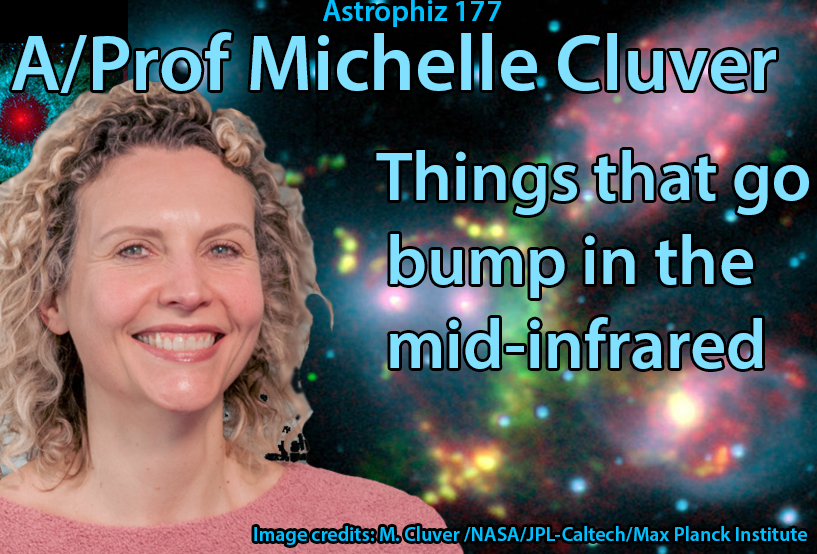
“Things that go bump in the Mid-Infrared”
Audio file link & full transcript below image
Listen link: https://soundcloud.com/astrophiz/astrophiz-177-aprof-michelle-cluver
Full Transcript:
Welcome to the Astrophiz podcasts!
My name is Brendan O’Brien. And we’d like to acknowledge Australia’s first astronomers, the Aboriginal and Torres Strait Islander people, the traditional owners and custodians of the land we are on.
This episode is produced on Yorta Yorta and Wurundjeri country.
And we’re asking you to influence your local politicians with the message that we really need to change our energy policies and move to renewable energy sources to mitigate the effects of climate change.
And each month we love bringing you two fabulous episodes.
On the first of each month, our friend, molecular pharmacologist, toxicologist and amateur astronomer Dr Ian ‘Astroblog’ Musgrave brings you his monthly SkyGuide with all the essential observational highlights for telescopers, astrophotographers and naked eye observers.
Each month, Ian also includes ‘Ian’s Tangent’ where he takes us on a short journey of astronomical wonder.
In the middle of each month. We bring you an exclusive and in-depth interview with a noted astrophysicist, astronomer, particle physicist, radio telescope engineer, data scientist or space scientist.
And right now, we’re going to zoom down to Melbourne Australia, to speak with an astrophysicist whose work, and her approach to her work is inspiring.
You’ll hear all about infrared astronomy and her amazing galaxy research from Associate Professor Michelle Cluver.
Brendan: Hello Michelle!
Michelle: Hello Brendan!
Brendan: Today listeners, you’re in for a very special interview. And I’m very happy to introduce you to Professor Michelle Cluver, who is an Associate Professor at the Center for Astrophysics and Supercomputing at the Swinburne University of Technology in Melbourne Australia.
And there, her research is focused on the largest structures in our universe … the physics and chemistry of Galaxies, supermassive Galaxies and clusters of Galaxies. And she uses mid-infrared data to see what’s happening behind and inside immense dust clouds that normally obscure our view of these distant Galaxies, which in turn can tell us what our universe was like when star formation was at its peak.
And Michelle has been a Super Science Fellow at the Australian Astronomical Observatory, a National Research Foundation Multi-wavelength Fellow at the University of Cape Town, and an NRF research career advancement fellow at the University of Western Cape.
And then she joined Swinburne in 2018 as an Australian Research Council Future Fellow where she has a prodigious output of work which is helping us understand how Galaxies evolve.
And she’s also the Co-PI of the 4MOST Hemisphere survey which is obtaining redshifts and spectra of close to 6 million Galaxies.
So thanks for having a chat with us today Michelle.
Michelle: Oh … Thank you Brendan for that wonderful introduction. That’s overwhelming to actually hear it played back to me like that, but you did a wonderful job of summarizing my work and my career. So … so thank you so much.
Brendan: No worries. Thank you! That’s great. OK, so before we talk about your research programs, your academic and supervision work, can you tell us where you grew up please, Michelle? And could you tell us how you first became interested in science and space?
Michelle: Yes. So I’m from Cape Town, South Africa. Well, I’m actually from the northern suburbs in Cape Town. And I have to say that I grew up in a very privileged position because my dad is actually a palaeontologist.
Brendan: Cool!
Michelle: And more than that, he was director of the Natural History Museum in Cape Town. And so I grew up surrounded by, you know, the most amazing museum collections and books.
I have a set of Encyclopaedia Britannica that go back to 1897.
And I literally grew up surrounded by science. And when it came to astronomy, my dad was an amateur astronomer and he actually built his own telescope, he ground his own mirror. And I got to see Halley’s Comet in 1986 as a 10 year old. And you know, when you’re a kid, you’re just, you know, this is just life. You’re just growing up.
As I’ve gotten older that I’ve learned to appreciate the fact that science was something that was sort of second nature to my family. And as a result of my childhood background, I was interested in a whole host of different areas of science. And so it actually was a little bit difficult to decide what science I would actually focus on. And so when I went to university, I actually studied physics and chemistry and I did introductory astronomy courses, but it was the physics that really charmed me, I have to say.
And at that stage in South Africa pursuing a degree in astronomy didn’t seem like a particularly good idea.
There wasn’t a lot of demand for astronomers.
And so I continued in physics and I got my degree and then I actually ended up teaching high school maths for a few years. And then I was in a very fortunate position where because South Africa was getting very involved with the Square Kilometer Array as well as building a massive optical telescope, the largest one in the Southern Hemisphere, they suddenly realized that actually they needed astronomers.
And so there was an opportunity to go back to study and basically build on my Honours degree in Theoretical Physics and go into a Master’s in Astrophysics. So astronomy was something I was always really interested in my high school job.
A bit of nepotism here … I was taking tickets at the Planetarium in Cape Town, which was part of the Museum. So I managed to get a … a nice cheeky job that way and taking tickets, you know, I got to watch the shows and get to see the planetarium operators do their thing.
And … and so I was exposed to astronomy and it was really fantastic to see some of the telescopes that were planned for the future and some of the exciting things that governments were investing in. And so I was very fortunate to actually be able to make a career out of that. But I’ll be completely honest that I didn’t actually think that it was going to be possible. So it was only much later in life that I realized I was going to become an astronomer. And it, it was a bit of a surprise, to be honest.
Brendan: Fantastic! OK. That’s a great back-story and having a palaeontologist in the family, I’m sure you went on some interesting field trips there. Now … you did mention … you did mention your degrees, your Theoretical Physics and your Masters.
We’ll talk a little bit about your PhD in a little while, but I’m interested in that transition that you made. You were teaching maths there for a while and we know that teaching maths is incredibly important in the digital “instant gratification” world we live in.
And we also need a lot of … we need a lot more women teaching maths, not only to just to be there, but also as role models, but is there a back-story there Michelle?
Would you like to tell us about that career move that you made from maths teacher to astrophysicist?
Michelle: Yes, certainly. An interesting one … while I was an undergraduate and while I was doing my Honours degree, I was doing part time work teaching extra lessons in mathematics and, you know, as well everywhere in South Africa too, there was great demand for students to get extra lessons and some extra help. And so it was a great way to keep me afloat as I continued my studies … and I enjoyed it … and I still enjoy teaching very much … and it’s incredibly rewarding.
And so when I finished my Honours degree in Theoretical Physics, I was at a bit of a loss because I wasn’t exactly sure what I wanted to do. I didn’t want to continue in in theoretical physics.
As I said, astronomy wasn’t really an option.
There didn’t seem to be too many opportunities in that area.
And so I was given the opportunity to continue to do extra lessons, but then also go into schools and actually teach students as well and … just in high school maths.
So I did that for a number of years.
And as I said, it was incredibly rewarding and I really enjoyed getting to know the students figuring out how best to help them.
But I have to say it’s a very demanding job!
And for anybody who’s been a teacher, I have just the utmost respect because it is exhausting … demanding … and you have to be completely in the moment with your students the whole time.
And you’re also thinking about, you know, how you’re teaching something and then you’re getting feedback from the student as to how they’re understanding the concepts that you’re conveying.
So it’s an incredibly demanding job.
And so I found it to be just really taxing actually and quite stressful too because you understand what you’re teaching, but then trying to convey it to someone who then has to go on and, and use it, you know, you can’t go and write the exams for them and you end up caring about these students so much, you see them putting in the effort and you know, you just really want to help them.
But I have to say the one thing that actually ended up being the tipping point for me was that after a couple of years of teaching the same syllabus, I actually found that I was losing the passion a little bit because it wasn’t stimulating.
I sort of figured out all the different ways in which to teach students a particular thing like factorization. And then I was teaching countless students how to do this one particular thing and it just became really almost robotic and I realized that I really wanted to use my brain and, and get a little bit more stimulation.
And so for me, I suddenly found that it wasn’t quite as satisfying and I can sort of describe it as a … a love for ongoing learning. I wanted to learn new things and be able to sort of analyze them and think about them and basically just expand my horizons.
And so I then started exploring what sorts of postgraduate degrees would be appropriate for me. And it turned out that there was this opportunity to go into a Masters of Astrophysics with my background. And so that’s what I then ended up doing.
Brendan: Ok, Michelle, thank you. Let’s continue your astro journey, please. You mentioned your Honours and then you went on …we’ll talk about this in a bit of detail in a minute, but you produced an award winning PhD thesis.
And then you headed over to Caltech in the States … to the California Institute of Technology Infrared Processing and Analysis Center.
And then you landed your first post doc research position at NASA’s Spitzer Science Center. Now, would you like to tell us how you first got to work with that beautiful Spitzer space telescope which has enabled so many amazing discoveries since its launch way back then in 2003.
Michelle: Yes. And it’s really a wonderful example of being at the right place at the right time.
And I have to say that my career has had a fair dose of luck involved.
And this would be a very good example of that and how one thing leads to another and one door opens and then another door opens.
So what actually happened was I chose my PhD topic having spoken with my potential supervisor about a number of … of projects.
So as it turned out part of my PhD project was focusing in on a particularly interesting galaxy. And this galaxy actually lies behind the Milky Way which makes it incredibly difficult to study and essentially impossible to study at optical wavelengths.
And so my PhD supervisor and her collaborator who worked at the Infrared Processing and Analysis Center had submitted a proposal to Spitzer to actually get imaging and spectroscopy data of this galaxy.
When I joined the PhD project, it wasn’t clear that this data would actually be forthcoming. But we were very, very fortunate to get time on Spitzer to study this galaxy.
And so I was actually sent to Caltech to IPA to actually work on this galaxy there and learn from the people who were building the pipelines and knew everything about the Spitzer Space telescope to actually learn from them, how to interpret this data, how to reduce it, how to analyze it.
And that was just such an incredibly rewarding experience, but it really changed the trajectory of my career. So not only was it incredible to have the opportunity to actually go and have this working visit at Caltech.
But I also got to meet a lot of the other scientists who worked there.
And some of them were very involved with Spitzer and some of them were working on future missions like Herschel and WISE.
And … and as a result of some of the conversations I had, people said “Well, you know … you’ve learned a special set of skills, you know, working on this particular galaxy … and these skills are really sought after because we’ve got all of this Spitzer data … So you should look out for postdoctoral positions coming up in the future”.
So I went back to Cape Town and finished up my PhD and it turned out that the data we got from Spitzer was just fantastic.
It was just, you know, so much more interesting than what we could have imagined.
Um … So it was a bit of a gift actually. And so the Award for the PhD really, I have to thank the universe for giving me some really interesting results to work with.
Um … But I went back to Cape Town and then, you know, the job ads would come out and I saw one that I thought, “Well, this fits in really nicely with the skills I already have”.
And so I applied for that and that’s actually how I got the postdoctoral position at Caltech.
And so I got to go back and work with slightly different people, but at the same place, which was just really fantastic.
It’s like a big family.
Um … It’s, it’s not a very big Center and Spitzer forms part of it.
And then as I said, Herschel and WISE, but just an incredible group of people, just the most fantastic scientists … but incredibly down to earth and so willing to help you … like you could go and knock on anyone’s door and say: “Hey, I’ve got this problem. I hear you’re the expert” … and they would be like, “Sure … let’s talk about it”.
It was just the most incredible experience to have as a student!
Brendan: Fantastic! It sounds like a lovely community that you got started off in there … and I love your idea of “Thank you Universe”.
That’s a wonderful journey… OK … Let’s go back now and have a look at that PhD you produced … because it looks like it had a lasting impact on your later research I think.
So your thesis is titled “The Nature and Nurture of a Starburst Supermassive HI Galaxy HIZOA J083643”
Now, can you tell us what’s special about this galaxy and the methods and the instruments that you used to unravel its secrets?
Michelle: Absolutely!
So it’s actually really interesting because this galaxy was discovered in Australia.
So there was a big HI survey that was done with the iconic Parkes radio telescope … iconic Parkes … called HIPASS.
And what they did was they also did an extension that looked at the ‘Zone of Avoidance”.
So the zone of avoidance is essentially the Milky Way.
So it’s where astronomers tend to not want to work because it’s really difficult to study anything other than the Milky Way.
And so to try and study Galaxies that are behind, it is quite tricky.
Of course, with HI, it’s a little bit easier.
So at radio wavelengths, but yes, in optical, and even in the infrared wavelengths, it’s a zone of avoidance.
So, you know, “Here be dragons” … and I must say, you know, part of my PhD was coming to grips with doing work in such an incredibly challenging part of the sky because as we look at the Milky Way in the optical, which is, you know, really beautiful … you see lots of dust and you see lots of stars.
And so if you’re trying to look at Galaxies that are behind the Milky Way, it’s incredibly challenging to find them and then to … to measure their properties.
So HIZOA was discovered as part of HIZOA J083643 galaxy was discovered in a HIPASS survey and it was discovered because it had an enormous amount of neutral HI gas, so neutral hydrogen gas, this very large extended disk … and then it happened that it was located, you know, behind the Milky Way.
And so in order to do any follow-up observations … you really have to go to … to mid-infrared wavelengths.
So it’s entirely invisible at optical wavelengths.
But in the infrared, you can ‘just’ see it.
And then in the mid-infrared … so slightly longer wavelengths … it turned out to be incredibly bright.
And so that’s where the Spitzer data came in.
And that proposal was really just, well, you know, we’re hoping we’ll be able to see it and it turned out to be incredibly bright in the mid-infrared because it’s actually forming a huge amount of stars.
So that was the very lucky part, it was very easy to study. And we got imaging and spectroscopy.
And the thing that I realized was that the way that the star formation was distributed in this very large disc was very similar to the local Galaxies that we see.
So the big spiral Galaxies forming lots of stars, it’s just that this galaxy was so much larger.
And so it really was just a scaled up version of the sort of typical star forming Galaxies we were seeing in the nearby universe.
And so that made me think: “Well… is this something which would be more likely to be found at higher redshifts when Galaxies we believe had much more gas”?
And so their mode of star formation would be a little bit different.
And so I like to call it the “Coelacanth Galaxy” … which was a fossil fish that was discovered just off the coast of South Africa … because it was … it was unexpected to find a nearby galaxy that … that had this, you know, extended star formation in its disk very similar to what we think the way that Galaxies at a redshift of Z1 are forming their stars.
And so it’s a really powerful analog for star formation we think was more typical at, at higher red shifts.
So that was a bit of a gift to have data that first of all was so excellent because this galaxy was so active. And then secondly, that was so interesting.
Brendan: Thank you Michelle. It sounds like you might still have a soft spot for that region of space hiding behind in the Milky Way.
Ok … Let’s move on … Would you like to tell us about your circumstances or the people who inspired you to head over to Sydney in Australia that first time? Then a bit later you returned and you came down to Melbourne and you’ve got your current position as Associate Professor at the CAS at the Swinburne University of Technology’s Center for Astrophysics and Computing.
What were the influences there?
Michelle: Yes. So getting to the end of my Postdoc at Spitzer, I started thinking about where else I’d … I’d like to go … and especially in terms of using this … you know… knowledge … that I picked up in the … in the mid-infrared … but also to work on something a little bit different.
And so I had travelled to Australia twice … I think to use first of all, the Mopra Telescope in New South Wales, and also the ATCA, the Australian Telescope Compact Array in Narrabri.
And so I’ve made two trips to Australia and I just thought it was the most amazing place. So just the bird life alone was, you know, absolutely wonderful.
But also I gotten to chat to people who worked at the ATNF, the Australian Telescope National Facilities, and in Marsfield in Sydney was the Anglo Australian observatory. And so … so on the same precinct, you had the optical astronomers as well, and they all would have lunch together. And so I started to … to speak to people there and they were telling me about the AAO at which is located in Coonabarabran in New South Wales, and some of the instruments and projects that were happening there.
And so once again, you know, started looking at the at the job register and there was a … a job opportunity to work with the GAMA Survey. So GAMA stands for Galaxy And Mass Assembly survey.
And this was this incredibly ambitious project to get 250,000 red-shifts in three very special fields. And the idea was to bring in a whole lot of multi wavelength data to create this incredibly powerful data set to study galaxy evolution.
And so I thought: “Oh, well, you know … I … I know the mid and infrared and … um … so I could certainly help with that”.
I didn’t know much about optical spectroscopy or redshift surveys, but you know, that’s part of the fun. And so I applied for the job and then … um … I managed to get the Super Science Fellow position, which allowed me to start working on that project … and that opened up a whole new area for me, which was … um … large redshift surveys and sort of large scale galaxy evolution studies.
So I’d worked on HIZOA, I’d worked on HIPASS and compact groups. So, you know, relatively small systems, small studies, I’d never done anything sort of at scale, you know, out to redshifts of 0.5.
And so… this really opened up a whole new world for me and a whole new window onto the universe.
So actually studying how Galaxies are evolving over time.
And so yes, that was a real juncture, a really important transition for me … a … a sort of an important turning point in terms of how my projects have developed since then.
Brendan: Fantastic! I can hear the excitement in your voice when you’re describing those projects, Michelle.
Oh … and just one more thing before we really put our science hats on … can you outline your current role and responsibilities at the CAS, at the Center for Astrophysics and Supercomputing?
Michelle: Yeah. Sure. So I’m a researcher but also a lecturer.
So I teach a third year course which is “Stars to Black Holes”.
So a little bit of stellar astrophysics … and then I’m a researcher.
So when I’m not teaching, I’m basically working on all my other projects, I have a few sort of service roles. So I’m involved with the outreach team. And one of my other roles is that I’m actually the representative on the Council for the Australian Astronomical Telescope. The AAT … I’m Chair of the Finance committee.
So, yes … trying to … trying to keep things.
It’s … it’s very expensive to … to keep a telescope going.
Especially one that’s been around for a couple of decades. But, you know, she’s just such a … an amazing telescope and has done such amazing things and I think also has a real opportunity to do amazing things in the future. We’ve got some really exciting things that are about to happen in the Southern Hemisphere.
I’d like to say to people that the southern hemisphere is going to get a bit of a blow up.
So for decades, a lot of astronomy was based in the Northern Hemisphere. That’s where the big surveys and … and various new telescopes were being built.
There were a couple that were built in the Southern Hemisphere, but we have lagged behind. And so the big things that are coming are the Square Kilometer Array which Australia is very involved in.
Um … there’s LSST … which is the … the Vera Rubin Observatory … which Australia is also involved in … that’s in … in the optical.
And there’s also the 4MOST project which I think we’ll be talking about a little bit later. So there’s gonna be a lot that’s gonna happen. And actually, I think the AAT has got a … a real role to play, you know, being complementary to a lot of the other facilities that are … that are coming in the Southern Hemisphere.
Brendan: Amazing! I sometimes … I wonder how you’ve got time to sleep. OK …. Thanks Michelle. It’s ‘Science Time!’ … Strap yourselves in listeners … So Michelle. Let’s bring it up. Now… can you tell us about the 4MOST project? It sounds amazing. You’re the Co-PI on that. And I believe it’s both a new instrument and an incredible survey project to study 6 million Galaxies in five years. And look, I won’t ask you what number you’re up to right now. But could you tell us what should we know about the VISTA telescope itself? It’s got a three ton VICAM infrared camera on it. And please tell us about the foremost survey.
Michelle: Oh, absolutely! And I’ll tell you … we actually, we have zero redshifts at the moment. So I’ll … I’ll tell you exactly how it’s going. So actually this, as you said, had VICAM so it was an imaging telescope in the near infrared and it actually surveyed the entire Southern Hemisphere. And it also had a survey that looked at the Milky Way, the ‘zone of avoidance’ and various other specialized projects.
And then a couple of years ago, the ESO, who runs the telescope and also the site where it’s located in Chile, decided that actually they wanted to convert this imaging telescope to a telescope that does spectroscopy.
And so you know, where do you go to find people who know how to build multi object spectrograph?
Well, actually you go to Australia because they really pioneered the technology here. So they actually went to the AAO … um … the Australian Astronomical Observatory, and they asked them to design a multi object spectrograph.
So this means that you can do spectroscopy on not hundreds, but actually thousands of objects at the same time.
So the AAO designed and really pioneered a multi object spectrograph with just over 2400 optical fibers. So 2400++ optical fibers that you can put on objects in your field of view.
And it’s a … um … it’s a 4 m telescope. I think it’s a two degree field of view. So that was the … the start of the of the 4MOST project.
The challenge was, you know, you need to fill all those fibers and no single project, no single science case can actually do that.
And so 4MOST is quite revolutionary in that we have a number of surveys that don’t just share the telescope, but actually share the focal plane. So my survey that I’m co-PI of the 4MOST hemisphere survey is extragalactic. So we’ll be placing fibers on Galaxies and we’re tuning our selection. So we’re aiming for the … the relatively nearby universe. So going out to a redshift of about 0.15, and as you said, we’re … we’re targeting about 6 million Galaxies over the course of five years. So 4MOST … we’ll start up at the end of 2024.
So that’s why we don’t have any spectra yet. At the moment, we’re … we’re still trying to figure out exactly where to put our fibers and how we’re going to run the survey and how we’re gonna deal with all this data and …and we’re working with the rest of the 4MOST project. So as I said, we, we can’t efficiently… or no one can efficiently occupy all those fibers. So there are other extragalactic surveys who when we’re looking at a particular part of the sky, they’re like, “Oh actually, we’re interested in an AGN” or “We’re interested in some distant clusters”.
And so we can put fibers on some of the other objects in the field that you’re not interested in. But crucially, we share the sky with galactic surveys. So other scientists that want to observe the stars. And so you might say, “Well, what happens if you’re not looking at, you know, the the Milky Way that we see at night?
Well, you need to remember that actually the Milky Way’s halo is all around us, right? Because we’re … we’re in the Milky Way galaxy.
So no matter where you look in the sky, you see stars that are a part of our galaxy. And so we actually are sharing the focal plane so that at any given time, some fibers will go to extragalactic surveys and some will go to Milky Way objects including the Magellanic Clouds.
And so because 4MOST is in the … the Southern Hemisphere, so it’s in Chile, we get an amazing view of the southern sky which again, is … is relatively unexplored compared to the northern hemisphere sky.
So we’re expecting some really interesting things to come out of the 4MOST project that’s brilliant and a brilliant way of sharing resources.
Brendan: Fantastic Michelle! It looks like an amazing collaboration and that dry desert up high in the Paranal. It’s … aah … I’d love to go there one day.
Now … Let’s look at some of your most recent papers. I did find one in Monthly Notices … there was a paper of yours about six months ago where a team you worked with were looking at Dark Matter halos. Can you tell our listeners why our quest to understand both the effects of and the nature of Dark Matter is such a fascinating area of research.
Michelle: Yes, it’s really interesting because I tend to try and avoid working … um … in Dark Matter studies because I find it really frustrating actually that such an important component of our universe is something that we know … know so little about.
So, but it’s inevitable because it’s in everything, right? I mean, it’s the very fabric of our universe. So I do find myself often working with people where the observational data that I’m working with mostly that then can help us say something about the Dark Matter and the Dark Matter halos that Galaxies live in. So it’s sort of the ultimate in detective work, right?
And I have to say all of astronomy and all of science is just detective work.
Um… but you’re looking for something that you can’t see, you can’t detect, but you can see its effects … its gravitational effects on the stuff that you can see the baryonic matter. So in terms of the optical traces and the radio traces, looking at the HI, the neutral hydrogen gas, you know, we can see the effects of the Dark Matter.
And we know that the universe, when it started out, it was the Dark Matter that collapsed first and within those halos, then the Galaxies that we observe formed. And so it really underpins the framework of our understanding of galaxy evolution.
We … we just can’t come up with a theory that explains everything without understanding the … the nature of Dark Matter … and crucially, being able to simulate it.
And so this is where the theory people come in. So the people who build big cosmological simulations … um … so they’re actually working with the Dark Matter in their models and then, you know, bringing in the baryonic physics.
And so this is where I think the really important intersection of communities is and … and is coming now in the next few decades because I think we’re really ready with the kinds of data we’ll be getting from … from big projects like 4MOST to actually use that to test and validate the theoretical simulations.
But then also … um … to have new ones come from that … that will hopefully take us closer to the answer because you just can’t do this without having the theoretical background, but also having the computational simulations that can go to the beginning of the universe pretty much.
So it’s … it’s really interesting and it’s also obviously incredibly frustrating. But I think there’s so many astronomers now who are actually focused on understanding Dark Matter, but also there are experiments that are actually trying to detect it.
So I think we’re getting pretty close to a breakthrough. I think I’m saying this because if there isn’t a breakthrough, then I’m not exactly sure what we’re gonna do because it’s just so important.
We have to figure this out.
Brendan: Exactly! And I love hearing you talk about the communities. It takes a village to understand Dark Matter.
Michelle: It really does!
Brendan: Let’s diverge a little … many of our listeners will be aware of the impact of Spitzer and how it’s enabled us to see what was previously unseeable behind and inside those immense dust clouds.
But Spitzer ran out of its liquid helium back in 2009. And amazingly, the two shortest wavelength channels on its infrared camera continued to function with little change in sensitivity for another decade. And it just kept on sciencing until just a couple of years ago.
And now we have the JWST, the James Webb Space Telescope and it’s producing the most astonishing infrared science.
Now, what does the success of the JWST mean for you personally and your research, Michelle?
Michelle: Yes. So that’s such a good question. So with Spitzer, we had this amazing facility that gave us brand new eyes basically on the universe. And the thing about the universe is I always like to say that you don’t know what you’re missing until you go and look for it. And that was certainly true in some work that I did as part of my postdoc looking at Stefan’s Quintet, which is this amazing collision of … of Galaxies. And we went looking for molecular hydrogen, which almost seems like a crazy thing to look for in a … in a galaxy collision. Um … But it turned out there was masses of it in the system and then you kind of go back to the physics and you … you sort of figure out how this is even possible and … and you learn something about physics that is actually applicable to a lot of different scales, but also a lot of different situations and … and that’s the thing … physics is fundamental.
So, you know, it doesn’t matter what your laboratory is if it’s a … you know, a single galaxy or if it’s a, a big group of Galaxies or if it’s the nearby universe, you know, the physics is … the buck stops there.
So that’s what we’re trying to figure out. So Spitzer was really amazing and that it, it opened up this window and then frustratingly ran out of cryo just as people were going “Oh, well, now the question we need to ask and where we need to look is here”.
And as you said, the warm bands, as we call them, still continue to operate because space is very cold. And so it’s, it’s cold enough to still continue to do data. And I’m actually working at the moment on a sample that was observed during Spitzer’s warm phase.
Um … So it’s just really incredible the sorts of science that you can keep doing and astronomers are really inventive, right?
If you give them a telescope, it doesn’t really matter if it’s not working to its maximum mobility, they’ll still come up with really interesting things to look at. And so … um … before I talk about JWST, I might just mention WISE, which is the other mid-infrared telescope that I work with a lot.
So WISE, was actually launched at the end of 2009. So around the time that Spitzer was running out of cryogen and WISE was different because its spatial resolution is not nearly as good as Spitzer or JWST. So it’s got a relatively small mirror. Um … Let’s see, is it … 40 centimeter mirror? I really should know this.
JWST is a 6.5 m mirror. I mean, it’s, you know, it’s an incredible light bucket … But Spitzer was launched and surveyed the whole sky, which is incredibly useful because again, you can, you know, it’s slightly different science. So if you’re working on a particular region of the sky, you can go and get the Spitzer data to see what the mid infrared tells you about it. … But you can also start looking at and very large samples of Galaxies. So this is related to the work I was doing with gamma and, and actually what we’ll be doing with 4MOST is we’ve got this WISE data that exists. The thing with JWST is that it’s such a step change in terms of resolution and power that it actually, I’ll be honest, it actually hurts my brain!
There is an image of M74 which is this beautiful nearby galaxy face on and the spiral arms just look, there’s so much detail that you actually don’t know, you know where star forming regions start and where they end. And it’s just incredible!
And yes … it’s … it’s the, you know, the kind of fidelity that really makes you question your … I suppose your understanding, but also how you think about how Galaxies work.
And so it’s, it’s really powerful to, to see those images.
And I had a really great discussion with a colleague a couple of weeks ago and I was saying to her, you know, this image of M74 like, you know, where do you even begin to study this? I mean, it’s almost fractal in nature.
And she said, “You know what Michelle … I work in the Milky Way and this is our problem … like we’ve got all this resolution because the Milky Way is really big on the sky”.
And actually, I thought this was really fantastic because it really made that connection in my mind that we’re … we’re approaching, you know, the situation where we can study distant Galaxies in very similar ways to which we study our own galaxy, which you know, this just really blows my mind. And so you can really get into the details, you know, obviously our own galaxy is, is wonderful. But in order to understand its context within the rest of the universe, we really need to be able to do these detailed studies.
So of course, I’ve only spoken about the nearby Galaxies because that’s kind of where my passion lies. There’s this amazing picture of Stefan’s Quintet, which also hurts my brain because I just see this level of detail that I can’t quite comprehend how it all sort of fits together.
But then also this view on the very distant universe, which is so important for understanding, as I said earlier, you know, our, our kind of overall framework that we’re developing as to how our universe started and how things evolved. And so it’s really, it’s, it’s pushing astronomers because it’s making us question some of our assumptions.
And because astronomy like, like all science, it’s, it’s, it’s complex.
You’ve got to start somewhere, you’ve got to start. “OK. Well, these are my basic assumptions and then this is what I build on”, but we’re actually getting to the stage where we now have to question these assumptions and go, “OK, do we have to go back to the drawing board?”
And it’s really in these nitty gritty details. So it’s really exciting and, you know, there are a lot of really smart people out there, which is, you know, really fantastic, but I find it quite daunting actually because I think we’re, you know, we’re gonna be in a position where all these facilities are gonna give us so much data and we have to somehow make sense of it, of it all. I mean, there are some days when I go, “Oh my gosh, you know, where do we even start?”
It’s just such a fun career to be a part of. It’s so exciting and, you know, I’m so grateful to be an astronomer and I can’t believe people pay me to do this. I’ll be honest, Brendan, it’s incredibly humbling. And I think the, the really fantastic thing is that as a community, we’re really good at working together.
So there’s competition. But we realize that first of all, we’re really expensive and, and second of all, there’s just so much data and there’s, there’s so many different parts to this, like we have to work together if we want to be able to, to answer the big questions.
And so I really think that astronomers kind of lead the way here, the event horizon telescope that image the Black Hole in M87.
I think what a great example of people working together in massive collaborations. I think there were over 3000 astronomers involved with that, each one with a very individual crucial piece and, and contribution. And then going, “You know, as part of the greater good, I will make this contribution so that we can image a black hole”.
And I just think that … that’s just so inspiring that we will work together because we just want to know … like we’re so curious and we’re … we’re so interested in these questions that we will put aside our differences to say, right, let’s work together and get this done.
Brendan: Fantastic! And what a great segue into my next question, Michelle and the good news is in your community. I can imagine your university students walking out of your lectures, their brains would be hurting, but they would still have this incredible sense of fun. So, yeah, they’re very lucky your students.
Look, let’s segue … in our last episode, our listeners heard all about those huge data streams being produced by the MWA, the Murchison Widefield array. And we know that’s one of the three precursors of the SKA, the Square Kilometer Array. And we heard how Greg Sleap’s team are making MWA data available to researchers all over the world … to all of those communities. And then I saw that you’ve been giving lectures on the SKA to those lucky students and look, do you think the SKA is going to be another great science project like Spitzer that keeps on going, or the JWST or even the Curiosity Rover? They’re great projects that sort of under promise and then they overdeliver spectacularly.
Michelle: So I … I like that way of, of thinking about it. So, yes, I think that and … and all credit to the universe here again because the … the way it works is we come up with a certain set of ideas or a certain set of goals. And then there’s the question of, well, “What’s the technology that you need to be able to investigate that?”
So the Square Kilometer Array is something that’s been spoken about and thought about for decades. Um … So it’s been an incredibly ambitious project that has taken a long time to put together because it literally requires governments to work together.
I think the thing is that you have to start with “This is what we’re going to aim to … to answer, and this is the kind of data that we need and these are our sort of headline science goals.”
But it’s inevitable that when you have a telescope that really is a step change in terms of the technology that you’ve had before you see things that you don’t expect. And … and as I said, it’s all thanks to the universe because scientists will come up with weird and wacky ideas, but the universe will always kind of overplay whatever it is that, that astronomers can think of like real life is so much more interesting than fiction.
And that’s certainly very true in astronomy.
So it’s just been remarkable to see the discoveries that come from having something like the MWA. So something like Spitzer … James Webb is exactly the same.
So it’s those unexpected discoveries and it’s the unknown unknowns, right? And you can’t put in a telescope proposal that says, “I’m gonna go and look for the unknown unknowns” … because no one will give you time.
So we start off with sort of a predefined set of ideas.
But then it’s always … we know that we are going to see things that we didn’t expect.
And that’s what makes it so incredibly exciting. And so these, these new windows on the universe, just the number of papers that will, you know, come from them will greatly exceed what has come before, notably, because people will be writing about the things that they discovered during the course of their particular science question.
So I absolutely think that in terms of over delivering, as you say, it’s going to be really incredible.
And that’s the thing, you know, this is why astronomers get giddy about kind of new instruments and, and new telescopes because we just know that we’re going to see things that we, that we didn’t expect.
It’s that sort of quest for discovery that I think is, is so important, right? We’re, we’re detectives but, but also we’re, we’re really curious about what else is out there. And I think it’s just really fantastic when you get a data set and it makes you go:
“Huh? This is not what I expected … what does it mean?” And …
“What are the assumptions that went into, into this?”
“Who do I speak to that would be able to give me insight as to what it is that I’m seeing?”
We’ve got some people at Swinburne who are involved heavily involved with very key science projects on JWST.
And sometimes you’ll …you’ll see them in their offices and they’ll be like: “OK, I’ll just show you this image very quickly, but, you know, don’t tell anyone I showed you this!”
… and … you know … it’s … it’s just so incredible!
We’re …we’re just like little kids really in a … in a sweet shop because we’re just like “Where do I start?”
And … and yes … and … and the JWST obviously became a little controversial because so expensive technological advancements that have to go into something like a JWST and an SKA.
They are really incredible!
They are engineering feats beyond anything that the human race has accomplished to now.
And so you just know that, you know, that kind of technology can be used in other places as well. But I also think it’s really important for humans to push the envelope in terms of technology to try and do really almost ambitiously crazy things because I think it’s really good. It keeps us sort of focused on a big picture, but it also unites us, as I said before.
You know, if you want to do something incredibly ambitious, you need everybody to be on board.
So we should always be pushing the envelope like that!
Brendan: Fantastic! And that’s what I love about the current environment. It’s almost as if with science now we can expect the unexpected. So that’s why I’ve got my fingers crossed about things like dealing with climate change effectively.
Now, I’ve been looking at some of your other recent publications and we always ask a couple of technical questions for listeners who like to put their propeller hats on when they listen to an episode.
So could you talk us through some details of a particular paper or another part of your research that you’re working on right now? That’s driving you crazy or astonishingly exciting or maybe even both Michelle what’s going on?
Michelle: Well, yes, certainly I … I have to say there is a lot of … craziness or, you know, being driven crazy. So it’s interesting because I … I sort of divide my research into two separate parts.
So one is kind of the part that pays the bills. So that’s almost like the foundational work, the kind of benchmarking work I do.
So I’ll … I’ll explain a little bit more about that, but it’s not quite as glamorous as the other part, which is the really fun, exciting … the … the passion research, I suppose.
And that’s kind of like the things that I find particularly interesting and the science questions that I really want to push forward.
The first part is doing things like working on calibrations for how we get star formation rates from a galaxy.
So how many stars per year is the galaxy forming and also the stellar mass of the galaxy? So these are two quite fundamental parameters in galaxy evolution because it tells you something about the past star formation, that’s the stellar mass and the present star formation. So the current amount of stars that a galaxy is forming, is it forming lots of stars or not very many?
And Galaxies behave in statistical sense in a very similar kind of way. But individually, they’re a bit like humans, they’re all very special and they have, I wouldn’t say personalities, but they all have their own little story.
So it’s really useful to kind of identify the Galaxies that are going to be the most interesting ones to, to study further.
So I’m working a lot with nearby Galaxies and especially in preparation for the 4MOST surveys.
So when we have 6 million Galaxies, we need to be able to understand their …their properties, and be able to get the basic fundamentals quite quickly.
And so … so part of my work is kind of preparing for when we actually have the redshift to Galaxies in the nearby universe.
So the important thing to remember, and I’m sure your … your listeners are aware.
So it’s quite easy to take images.
But then you’re not sure if the fuzzy blog that you’re seeing is a relatively small thing close by or a relatively big thing far away.
So you need the distance, that’s the most important crucial piece of information. And so the red shifts give us distance, which means that along with the WISE imaging and optical imaging that we have near infrared imaging, we can then build a spectral energy distribution.
We can actually say, well, how bright, how luminous is this galaxy? And then we get to put them into little boxes because unfortunately, that’s where you have to start.
There are just so many and then we go: “OK, how do we take this further? What are the …what are the questions we’re gonna ask?”
And you know how we’re gonna build our samples to, to ask the … the big questions, so to speak. So that’s the somewhat unglamorous side of things … the slightly more glamorous.
But I say that with a bit of a caveat because it’s still kind of early days.
But I’m really interested in the gas, the neutral hydrogen that exists between Galaxies.
So we know Galaxies have neutral hydrogen because that’s how they form stars. So neutral hydrogen will turn into molecular gas. And once it goes molecular, it’s very difficult to not form stars from that, like molecular hydrogen really wants to form stars. But you’ll often have these big reservoirs of neutral hydrogen that kind of just sit there and they … they don’t do very much.
They’re, they’re very useful traces of Dark Matter though.
Coming back to that publication, you were talking about earlier, but then when you have a galaxy interacting with another galaxy, so Galaxies in the universe don’t tend to live in isolation, they tend to be in little groups or families.
And so as with typical human families, there are interactions and these can sometimes be a little bit distressing for the Galaxies.
So when they interact with each other, they can lose some of this reservoir and then it kind of just sort of sits there or, or does it?
So what happens when Galaxies interact is if they have this big neutral gas reservoir, then that actually tends to get pulled out. So because they’re acting gravitationally and … and the gas is experiencing slightly different gravitational forces, this gas gets kind of pulled out and almost left behind.
It’s actually interesting because the gas that sits more towards the center of Galaxies will actually get funnelled in towards the center in general, you get some … star formation as a result of that.
So there are these really interesting torques that occur.
It’s all just kind of angular momentum physics.
I like to call it gastro actually.
So the fundamentals are, are pretty straightforward.
The … the problem is that that Galaxies are quite complex structures. They’re these big ecosystems.
And the other problem is that invariably it’s not just two Galaxies, but you know, you have a couple more of them. So it’s a bit of an N-body problem and with every additional galaxy, it gets more complicated.
So … so this is where actually simulations are particularly useful for trying to understand … how Galaxies are interacting with each other.
So my interest is in this … this neutral hydrogen gas that kind of gets pulled out and it can kind of sit in the group and it’s not really clear what happens to it … if it just sits there and then gradually evaporates because galactic medium is quite a harsh place … or whether it actually participates in the evolution of Galaxies.
So you might say, well, “How did you get interested in this slightly niche, slightly odd part of, of Astrophysics?”
Well … I think I mentioned before Stephan’s Quintet, which is this iconic laboratory. I like to think of it.
So what happened in Stefan’s Quintet?
It’s a compact group of Galaxies. So it’s a quintet. So there are five of them and they’ve been interacting and they pulled out gas from each other and, and most recently from one galaxy in particular, we think, and then because gravity, one of these galaxies got thrown out in sort of a slingshot.
So in a very similar way to how we get to the very distant planets in our solar system. We do like a gravity assist. So this was obviously unplanned and one of the Galaxies got thrown out of the group and then of course, came back in and crashed into this group with a velocity of about 1000 kilometers per second.
And what happened was it collided, we think with some of this neutral hydrogen gas that was just kind of sitting there and it produced this enormous shock.
And so that in itself is kind of cool.
… but then within the shock, we discovered all this molecular hydrogen gas, which of course is fuel for star formation.
And it turns out that there’s some really interesting physics that we can learn from this. But also the shock is quite traumatic for the incoming galaxy as you can imagine. And so it’s a really high energy and quite extreme set of events.
And so my thought coming out from the work from Stefan’s Quintet is “What happens if Galaxies are interacting in a similar way, but maybe not as extreme, maybe it’s not 1000 kilometers per second intruder galaxy, but maybe what’s happening is as they’re interacting with each other, this neutral gas is in the mix and it’s causing lots of less powerful shocks. But, but also that is kind of traumatic for the Galaxies and causing them to lose more gas or, or maybe it’s giving them more gas for more or star formation.?
Who knows? … the problem is you’re talking about very, very faint stuff. So you’re talking about neutral hydrogen, which is, you know, is, is difficult to detect.
You need to have a lot of it. Fortunately it’s … it’s very abundant in the universe, but you’re talking about sensor activities below what telescopes can normally achieve.
And so I’ve been involved with some projects on MeerKAT which is the SKA precursor in South Africa … which is particularly focused on it’s a smaller field of view compared to ASKAP for example, or the MWA, it’s a smaller field of view, but it’s very, very sensitive and it’s really good at picking up this kind of gas.
And so as part of pilot studies, I’ve been involved and also led some work where we’re looking for this gas just to give us a better idea of what we’re going to see with the SKA when it comes online and where should we look and … and how are we going to extract this gas? You know, how we’re going to study it better because again, this is kind of a regime that we … we’ve not had access to.
And so the one piece of research that came to mind when you asked me this question was I targeted a particularly interesting group of Galaxies.
So it’s actually a long filament of Galaxies and towards the Center, there’s actually a compact group sitting within a larger group. And I thought: “Wow! This is the perfect place to look for this kind of gas!”
So we’ll … you know … we’ll ask for time on MeerKAT and, and let’s see what we see. And I was just convinced we were going to see intergroup gas. And the funny thing was we did pick up something, but again, it wasn’t what we expected at all. So where I thought we would see gas, we saw absolutely no gas.
And then further away, actually, my colleague was … was looking at this data set in VR. So we actually use virtual reality to, to look at our data because you’re working in kind of spectral space.
And so it’s, it’s much easier to actually pick up things that you’re not exactly looking for. And so he was looking at our data cube and he was like: “Wait a minute! What is this thing over here?”
And it’s this dark cloud of neutral gas that is … and it’s … it’s not kind of tenuous, which is what we were expecting. And it’s not where we were expecting it. It’s sort of towards the outskirts of the galaxy group, but it’s a huge amount of neutral hydrogen that’s not forming stars and that has no stars associated with it.
So it’s, it’s what we call a Dark Cloud.
So we … we have not come up with very good names for these things.
And the thing is we have no idea what it’s doing there or how it came about because it’s not clear that it’s been pulled out of any Galaxies in particular. There’s nothing around it.
Did it just condense out of the filament? It’s really quite bizarre!
And so the other thing that we picked up, so it’s a large amount…it’s almost like a galaxy amount of HI that’s kind of sitting there.
And so we’ve asked for follow up observations on MeerKAT with better resolution and better sensitivity. So we can try and study it better because we literally have no idea what this thing is doing.
And the thing is if we’re gonna be seeing lots more of this kind of gas, then we really need to take it seriously. So in some ways, it’s a bit of a vindication because I’m like, I knew this was gonna be interesting in the other sense, we’re really going to need to start thinking about how this falls into our picture of galaxy evolution. Like we’re not really taking into account this intergroup gas in, in simulations.
Is it something that plays a role in … in how Galaxies are evolving?
So the exciting thing is that the …that data has just finished being taken by MeerKAT last week.
And so … my colleagues and I are going to be meeting in two weeks time to hopefully take a first look and … I’m just … I’m … I’m almost giddy because I have no idea what we’re going to see, but either way it’s going to be super interesting.
And actually just last night I got an email from another colleague who’s in Spain and I’m working with her on more hicks and compact groups. So not … not Stefan’s Quintet, but some of the other compact groups. And she got a whole lot of data … looking at these compact groups and we just see neutral hydrogen everywhere!
It’s just gonna be a amazing to try and form a complete understanding of how Galaxies are … are interacting. First of all, because the … the nice thing about the neutral gas is it acts like a bit of a smoking gun. So you can use it to piece together the interactions that have happened before, which obviously because of the timescales, it’s impossible to, to watch this unfold.
But the neutral hydrogen kind of gives you a clue as to how the Galaxies have been interacting with each other.
So yes, this kind of area is about to really just blow wide open and I think will become key area of focus for a lot of people because we’re, we’re gonna need to sort of tweak our understanding. But also we’re gonna need to figure out what the questions are that we need to ask and where we need to look to understand this better.
Brendan: Fantastic! What I …ah … I can hear so many different things in your voice. I can hear the brain pain. I can hear the anticipation. I can hear the excitement. That’s fantastic Michelle! Oh, thank you. Ok. Look, let’s get down to mundane things. Now, after such amazing stories about the interactions between Galaxies and these … uh … lost clouds of gas … my plan is to hang around until Andromeda crashes completely into us.
Michelle: Heheh!
Brendan: … But in the meantime, can you tell us what you do on a daily basis as a university professor?
And now we know what you do as an astrophysicist … but …
What’s a day in the life of a university professor look like Michelle?
Michelle: Oh, I have to say every day is a little bit different! … I spend a lot of time on my computer. So … I’m usually doing some coding and analyzing some data. I attend a lot of meetings.
So particularly with this new 4MOST project that I’m involved with. I’m involved with the people that are organizing the … the whole project as well as my own survey. And so there are about 75 people in the 4HS survey that I co-lead.
And then there are about 700 people in the 4MOST project.
And … we need to figure out how to keep everybody happy in terms of the science we’ll be able to do and the data that we can deliver.
But at the same time …we’ve got about 18 different surveys that are gonna be run over a five year period.
So it’s quite ambitious, as I said, and it’s a tricky thing to organize and … and … and keep everybody happy. So … so that takes up a fair amount of my time.
Then I have my students, which are great because … while you’re busy doing one thing, your student is, is off there doing science and … it’s kind of science happening in the … in the background that you’re not having to do yourself.
So … it’s really … I … I really enjoy working with students and it’s just so great to … to see the talent that’s coming through at the moment and just also … being so comfortable with coding and technology and, and figuring things out … So I’m really fortunate to work with some really excellent students who work on, … on data analysis and group finding and writing code and they … they’re just wonderful!
I have regular meetings with collaborators. So I have some of the key projects that … that I’m very involved in that I lead and Co-lead.
But then I’m also working with a lot of other people on … on slightly different science topics. And I really enjoy this actually because … when it’s something that’s not quite my area of expertise but sort of related, I love to be able to learn about that.
And I … I just love learning new things and I think it also makes me a better scientist if I hear what other people are doing and how they’re using sometimes my data or sometimes data that I’m helping them understand.
So I have a number of … of collaborations that I’m involved with from … very nearby Galaxies to cosmology experiments. And … I’m not a cosmologist. So it’s … it’s really wonderful to …to work within the community.
I love … I love working with people.
And so the data is probably the most fun aspect for me and, and going to telescopes or … or getting data from telescopes. But then it has to be the people that I get to work with.
And I always say to my students, I’m never the smartest person in the room. I’m generally not even the 20th smartest person in the room. And I just think it’s wonderful! I love learning from … from other people and using my own expertise, but also hearing other people’s expertise and … and learning from them.
Brendan: Fantastic Michelle! And as you’re doing it, you’re breaking stereotypes about both science and scientists. OK … Look right now, it might be a good time to ask you about the global COVID-19 crisis.
I keep on hoping that it’s over and I don’t need to ask this question in the interviews, but it’s not quite the case yet over here in Melbourne, the numbers are certainly going down dramatically, but hopefully, this might be the last time I asked this question.
I hope you and your family and your colleagues and your corgi have not been impacted badly.
Have there been lessons learnt and how has COVID impacted on your academic work and on your amazing research?
Michelle: Yes, it’s a good question. Firstly, to answer one of the things you mentioned, my family and I managed pretty well. I will have to say that I felt that I was in a position of immense privilege because while we were in COVID lockdowns and … during the deepest darkest days, as opposed to being someone who actually had to go and work in a hospital and be on the front lines …
I got to be on my computer and work on Galaxies far, far away, like literally very escapist and very far removed from … ‘reality’ in inverted commas.
And so for me … it was … I was just so fortunate that first of all, I could continue to do my work and in fact, in some ways, it was really beneficial because … what else is there to do?
And … one of my colleagues and I, we managed to finish a whole lot of measurements … of nearby Galaxies we’ve been working on for, oh my gosh, close to a decade, at least five years. And you know, sitting at home not having too much else that you can do. We … we managed to get a huge amount of work done, which is what we’re busy analyzing at the moment.
But yes, as I said …I just … I felt so lucky to be able to continue to do my job, but also to be able to pull away from that and actually just get lost in my own little world … the universe.
And yet it was incredibly tough. It was incredibly isolating … the dogs loved the fact that I was at home every day. And so they’re still struggling a little bit with me going into work.
But yes … I … I would say that … for … for me … I … I’m, … I’m very fortunate that … it wasn’t exactly a net positive, but I could turn it into something into something good.
And I realized that so many people had just, you know, an absolutely heart wrenching experience and had to do such incredibly difficult things over that time.
I’m just so grateful for … our health care workers and … for the people who … who did it really tough.
Brendan: Yep … we owe our health care workers a huge debt of thanks. Ok. Now Michelle, you mentioned your students just before and I know you’ve got a long history of mentoring … of teaching … PhD supervising. And I think you mentioned outreach earlier.
Are you taking inspiration from the students who come to you?
Michelle: Oh, absolutely! Especially the students that come through. They … they all have their own stories, right? I mean … I guess that’s true of … of everybody, but everybody finds their way into astronomy in a slightly different way. And so I particularly enjoy hearing the background of students and understanding … what astronomy means to them.
And I’m sure you’ll agree that astronomy is a little bit special and it’s interesting because we get people from so many diverse backgrounds.
And when I was in South Africa, I had a student from the Ivory Coast and he is actually the first person in the Ivory Coast to get an Astronomy PhD. And just to hear about his background and his circumstances just so different from my very privileged background of having a dad that was a, a palaeontologist. It’s incredibly inspiring to hear what … studying physics and astronomy has kind of meant to him and his family and he’s doing incredibly well …I was actually just emailing with him last night because some of this new MeerKAT data that we’re gonna get on that we’re gonna get in soon on a slightly different project. He’s gonna be very involved with that.
Just really fantastic to build these lifelong collaborations and to have colleagues that you’ve seen and known since they were very young students to then … having their own students at universities.
So, yes. So I’ve had quite a broad diverse spectrum of students and they’ve all gone on and, and done very interesting things, not all of them have … have stayed in astronomy.
It’s incredibly humbling to be a part of a journey like doing a PhD with somebody because it’s … it’s such a tough thing and it becomes … almost overwhelming. Right?
It’s all consuming and to … to help guide somebody through that … that process and see them grow as an independent researcher is really fantastic!
But the other thing that I think is really important with students is, and … and this is true of most astronomers … but they … they all have strengths in slightly different areas and astronomy is one of those fields where you can really focus on your strengths or your interests even.
So, if you’re really good at coding, well, you can do that. If you’re really good at theory … then that’s great. If you love telescopes and all things data, then … there’s a place for you as well.
It’s really exciting to have projects and then to speak to the student and then to gradually see where it is that their … that their passions and their expertise is forming and to sort of basically tune the projects to … to get the most out of them as opposed to having a predetermined project and then forcing … a square peg into a round hole.
And I think astronomy gives you that flexibility because there are always different avenues that you can explore. And I was just discussing this with my student yesterday actually. We were talking about future papers.
And I said … “Well … after you’ve done this particular piece of work, then it’s important for you to say, actually this is the thing I’m really interested in investigating or maybe it’s this thing.”
Like … it’s not actually for me to say, because I don’t have to do the work. “You’ve got to do all the hard stuff.”
So I think that … that’s so important and it’s something that I… that I really enjoy. As I said, I enjoy working with people and so with, with students. It’s particularly rewarding.
Brendan: Fantastic! Yeah, beautiful! OK. This next generation of young scientists … the ones you’re working with and the ones all over the world … they’ve got some fantastic opportunities and some profoundly worrying challenges ahead of them.
So Michelle … finally … the mic is all yours now and you’ve got the opportunity to give us your favorite rant or rave about one of the challenges that we face in science … in equity … in the representations of diversity you’ve just mentioned … in science denialism or career paths or your very own passion for research … or what’s our general human quest for new knowledge?
The microphone’s all yours now.
Michelle: … it’s quite daunting. I have to stay.
Brendan: Sorry …
Michelle: No … no … that’s all right. I don’t tend to rant much, but I have to say that I am … I guess … I’m a little depressed about the current state of things in the world and maybe people say this all the time, but you mentioned climate change and this is something I find particularly worrying.
But I think it’s also connected to the fact that I’m very sad that people consider science and maths and physics and chemistry to be very separate from their lives.
When I think we’re all scientists, we’ve been scientists for, for millions of years. You know, everybody is a detective every day. You’re assessing information and deciding what to do with it. And it really makes me sad that people don’t see science as being so much a part of their lives … but not as … you know … people being taken along for a ride … but actually something that they’re actively participating in.
And so it makes me sad when we … we have this kind of denialism and I … I always say to … well … actually it’s a friend of mine who has a saying which is “I’m not that kind of doctor.” … So we talk about the fact that we know about astrophysics and even then we know about sort of narrow parts of astrophysics and when it comes to something outside of our expertise, then …we want to defer to somebody who dedicates their time to understanding that.
So whether that’s in the medical field or in engineering or … or whatever it is … I … I will defer to the person whose opinion, I think carries a lot of weight because of …their qualifications and … and … what they’re focusing on what they’re putting their … their time and their energy into that doesn’t mean that I’ll be happy with just one opinion.
And I think that’s the important thing for people to go: “Well …I … I need to formulate my own opinions about things. I need to be able to gather information, assess it and then decide what the next step is.
And so that’s what we do in astronomy and science … we … we’re detectives but people are doing this every day as well, and to actually think about how we’re getting our information and ..,. and what we’re doing with it, I think is so important.
And I guess I’m sad because I think about how we have … our … our mobile phones, which are just the … the most incredible computers.
I mean … this … it really blows my mind how technology has advanced in the … in the last 50 years or 100 years.
I … I have a set of Encyclopedia Britannicas that go back to 1897.
So you don’t even read about airplanes, right?
I mean, it’s just remarkable! So we have access to computers, to phones and the World Wide Web is just the most amazing thing.
Like … literally … I will think: “How does this work or how do I do this?” And I will have so many sources of information. It’s just fantastically empowering, but I feel like we’re really getting bogged down in all the worst bits of it and … and I think we’re really … we’re losing the forest for the trees.
Like I think we kind of lose the … the big picture here And so I suppose the thing that I would hope is that we all recognize that we’re … we’re on the single planet … we’re all in this together and that we really need to be thinking about each other.
But also I think we need to make good decisions, right?
And not just us, the politicians, everybody, I think every day we need to make good decisions.
And so we should be gathering the facts, the evidence.
We should be getting lots of opinions from people that we … people that we know are experts in things.
And then we all need to be working together because I think that this is just gonna become so important and this kind of ‘lone wolf’ idea.
I mean, 50 years ago, astronomers tended to be lone people, you know, up at a telescope working on their thing being very protective of their science in astronomy. We’ve learned that that’s just a dumb way to do science and it means we can’t do more.
And so I think we really need to realize that we need to work together and we need to find a way to work together and to … and to help each other.
So I suppose they did end up being a bit of a rant. Um But I … I hope that made sense.
I … I think of Carl Sagan … and I just think his series Cosmos in the 1980’s was just such a turning point f or…for so many people … and I think really kind of opened up science and astronomy and it’s really sad to me that …we’re not … we’re not really building on that … right … on that perspective and … and on those ideas that he introduced … and it makes me sad and I’m not quite sure how that’s happened, but I’d like for people to realize that science is … it’s in all of us.
And as I said, we’re all scientists and the end of the day, it will be the thing that saves us.
There’s a game that I used to play. Civilizations.
This is many years ago. And if you didn’t invest in your scientists, then your civilization would tank because your scientists invented things.
And I often think of that … invest in science … invest in your future.
Otherwise I really do worry.
So … so yeah … I guess that’s … that’s all I’ll say on that.
Brendan: Excellent! Thank you Michelle! And I’m sure many of our listeners will share those sentiments.
Is there anything else we should watch out for in the near future? What are you keeping your eye on?
Michelle: Oh, I’d have to say it. It’s what’s coming out of JWST at the moment. So I actually just had a colleague post something on Slack, which I believe was on Twitter. So I’m not actually on Twitter, but it’s great that other people share the fun stuff and it’s basically an image that shows the spectra of Galaxies in a particular field.
And just the amazing sensitivity means that there are thousands of red shifts that are being isolated in this field going up to … to really high red shifts. We’ve just never had access to this kind of data or this kind of sensitivity.
So I reckon JWST has a lot to say over the next coming years.
So … so people are now being able to process the data from the first year almost and … there’ll be … there’ll be just be so much that comes out of this.
So that’s really where I’m looking for the moment.
And then the next thing I think will be the SKA which will really revolutionize our view of, of the universe.
I think that’s where the … the next big announcements are … are coming in …to no surprise to anybody.
But I should also say that the Gravitational Wave folks are working on some really fantastic experiments. And unfortunately, this is well outside of, of my expertise, but it is really exciting to see how the improvements to the technology is just opening up the … the face space of what they’re able to study. And that’s really fundamental general relativity physics.
And … and I just think it’s so exciting because we can only learn from it and the more physics we know the better for everybody … that is always true.
So … so yes, it’s just … it’s … it’s a real kind of golden age of astronomy we’re approaching at the moment.
I’m not sure that we have the funding or the … the person-power … but the science will happen one way or another.
So … so yeah, it’s very exciting!
Brendan: Exactly! Thank you so much. Ok, we are out of time.
So, look, thank you, Doctor Michelle Clover … on behalf of all of our listeners and really, especially from me, it’s been fabulous!
Your students are so lucky! Thank you for your time.
This will go for well over an hour and you’ve …
Michelle: Sorry about that.
Brendan: No! That’s great! You’ve just donated over two hours of your time. So good luck with all of your next adventures … your next collaborations … your next communities and nailing those 6 million Galaxies and unlocking their secrets.
And I think that, you know, we can expect the unexpected, especially in that Dark Energy and Dark Matter realm and those teams will be looking at your 4MOST data with great interest.
Thank you!
Michelle: Thanks for having me Brendan. It’s been such a pleasure speaking with you today.
Brendan: Thank you Michelle!
Michelle: Thanks Brendan
< short Morse code clip >
Brendan: and remember Astrophiz is free and unsponsored. But we always recommend that you check out Dr Ian Musgrave’s ‘Astroblogger’ website to find out what’s up in the night sky … and in two weeks time at the start of the month, we’ll be bringing you Ian’s September Sky Guide
< short outro music ‘Radio Waves’ >
 The Astronomy Astrophiz Podcasts