
FULL TRANSCRIPT BELOW:
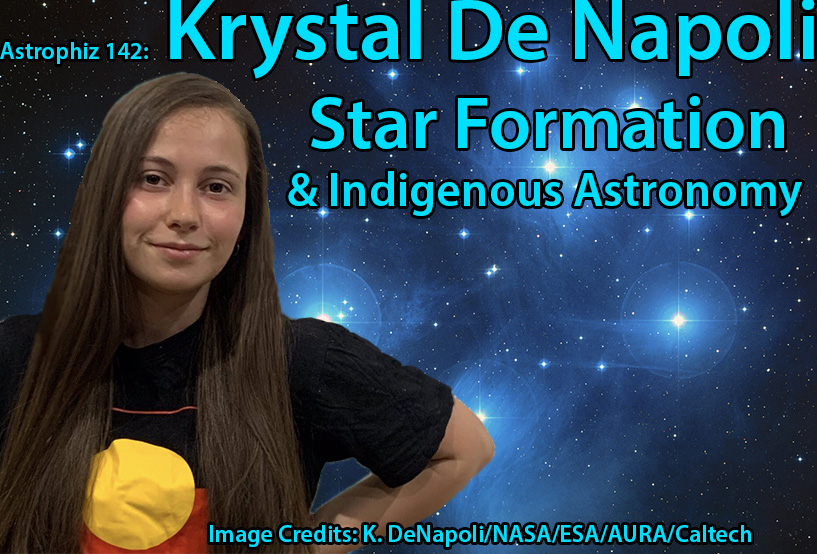
Krystal is a fabulous indigenous astronomer who is carving out a brilliant career for herself while she improves the educational prospects for indigenous Australians. She is currently based in Melbourne but grew up in the closest town to me here in North-East Victoria. After being awarded her first science degree, she is extending her B.Sc with Astrophysics Honours Research at Monash University.
She was recently awarded the Out for Australia ‘Young Professional of the Year’ prize for her outstanding outreach and contributions to indigenous communities
In this episode we hear about Krystal’s early struggles and how she now works on a regular radio show as she continues her Honours studies, and we get to put our science hats firmly on to hear how Krystal does research into star formation itself and how star formation rates can vary in different galaxies.
You will not hear a better description of what it is like to help passengers to observe auroras on an Antarctic bound 747, which Krystal has done, as well as how various indigenous storylines across Australia interpret auroras depending on their Latitude.
Krystal and Karlie Noon (see Ep 99) have written a book called ‘Sky Country’ which is part of the First Knowledges series published by Thames & Hudson and which will be out soon in April.
Enjoy this extended interview into a brilliant career in the making.
TRANSCRIPT:
Welcome to the Astrophiz Podcasts. First of all, we would like to acknowledge Australia’s first astronomers, the Aboriginal and Torres Strait Islander people, the traditional owners and custodians of the land we are on. This episode is produced on Yorta Yorta, Pangarang, Wurundjeri and Woiworung country of the Kulin nation.
My name is Brendan O ‘Brien and we always include a community service announcement to influence your local politicians with the message that we need to change our energy policies to move to renewable energy to mitigate climate change.
Today’s interview is with a wonderful Indigenous Astronomer and Astrophysics Honours student, Krystal De Napoli.
Brendan: Hello Krystal.
Krystal: Yama. G’day.
Brendan: Now for our listeners, I was lucky enough to see Krystal De Napoli being interviewed on ‘The Drum’ last year. And I knew we had to do a feature episode with this fabulous Indigenous astronomer who’s carving out a brilliant career for herself while she improves the educational prospects for Indigenous Australians. Krystal is a Gomeroi Astrophysics Honours student at Monash University researching the ways in which the love for her culture and her passion for science and astrophysics intersect.
She’s currently based in Melbourne, but grew up in the closest town to me here in Northeast Victoria. Thanks for speaking with us, Krystal.
Krystal: It’s a pleasure. Thanks for having me.
Brendan: Okay, so before we talk about your research programs, your outreach, work, and Indigenous Astronomy, can you tell our listeners where you grew up, please, Krystal, and tell us how you became interested in science and space in the first place.
Krystal: Yeah, so, well, Brendan, this is sort of something, I guess, that we have in common, but I grew up on Pangarang land, so in the town of Wangaratta, in northeast Victoria. And honestly, that’s been a really important aspect of my life that led me to studying astronomy and astrophysics, because as you would know very well, we have the most beautiful skies up in our region.
And for me, I got to grow up, you know, I always love to do a bit of exploring. So walking around town, even of a night time for me brought a lot of joy. And with that, I really got to take in a lot of our skies. And, you know, these are places where there’s pretty minimal light pollution. And it’s not perfect, but, you know, just stepping like honestly one minute to two minutes out of town, I can already see a lot of the dark sky features that you that are just impossible to see in the city.
And so it was something that always had me really inspired, being able to look up the sky and just seeing like a blanket of pretty much thousands of stars above me and always wondering a bit about what was going on in outer space outside of just our little planet. And so when it came to thinking about what career might I like to pursue and specifically like I loved maths. So for me, it was like, you know, what can I do that’s related to maths that also brings me some sort of joy.
And for me, yeah, astronomy and astrophysics was really like the most natural path forward. So that’s sort of how I got into what I do now.
Brendan: Cool. Okay, so what about your school days and your early ambitions and did those ambitions change?
Krystal: My school days, I would say that I had probably an atypical experience of education. So unfortunately for myself, I grew up in what I like to describe as like turbulent circumstances, which is just like a nice way of putting that I grew up in an environment that wasn’t particularly stable or safe, and it didn’t necessarily let me actually go to school. And so I was receiving disruptions in my education as young as primary school. I was needing to walk like five kilometers each way on my own, just to be able to get to my primary school.
And so for me, I always, I loved learning, but I had a lot of hurdles that prevented me from excelling. So it’s sort of a shame because I think I sort of got lumped in a bit of a box at times where like for me, I really, I really loved maths. I loved reading. I loved learning about new topics. I loved doing a little bit of research, you know, as kids, you get assigned a research topic to create a poster or something.
And for me, I had so much joy diving further into different areas of knowledge. And so I guess it would have seemed that getting to become a scientist and get into research would have been very normal, but unfortunately those hurdles in accessing education actually meant that I was sort of more lumped in a group that was at risk of not even passing.
And so, for me, I think it was when I reached high school that I started to really find things that I connected with, which was mathematics, particularly like starting off doing algebra. I found so much joy, it was sort of like solving a puzzle. And so that was something that sort of kept me engaged, even though issues with my attendance and my circumstances at home persisted all the way through my high school years, I did still really enjoy that aspect of getting to learn.
And unfortunately for me, a lot of these circumstances actually escalated towards my VCE, which is like the peak time, where students should be indoors studying, peace and quiet, just trying to focus on doing their best to achieve. And for me, I had just a lot of stuff going on that I couldn’t control, that a lot of really important stuff in my family that unfortunately prevented me from even attending school.
And so I was at risk of failing altogether. So I wasn’t going to get my VCE, which is very important to get to university as we have come to know from, I guess, in this period of time where things were getting very stressful and not looking likely that I would succeed, I was very, very lucky that I had a couple of really good teachers who noticed what was going on and decided to reach out to me and actually helped me structure a way forward to actually passing.
For me, without these teachers, I probably wouldn’t have gone to university. And so that’s for something that I’m really, really grateful for, even into this day. And it’s something I think is also really important to highlight, because I feel like we hear a lot of stories about kids who, you know, they’re very smart and they’re excellent and they do really well in VCE and then they get into their degree. And then, you know, a few years later, they’re already in a PhD, where for me, that is just not at all what my story’s been.
And so, Yeah, I think I just feel like it’s important to highlight those hurdles are pretty common and that for me here being able to sit with you today and having this conversation and being able to talk about any of my achievements It’s not something that was easily obtained and it’s something that really took I think like a community to be able to get me here/
Brendan: Yes, so a very turbulent school life and when you headed down to Monash University in Melbourne, where you received a Distinction for your Italian Language studies and you then graduated with your BSc, your Bachelor of Science, majoring in Astrophysics with minors in physics and mathematics.
And another huge part of your life is actively supporting indigenous education at many levels of outreach. Would you like to tell us about some of the admission and enrolment programs that exist for Indigenous students?
Krystal: Yeah I would love to. At a number of different institutions there exist programs which we can refer to as like access programs or enabling programs and they are specifically designed to help get students into university and they’re usually aimed at students who are coming from a background which you know faces atypical hurdles between themselves and accessing a tertiary education and it’s all about closing the gaps that we see in education particularly with having indigenous representation in our universities and in our graduates and so these programs are really important
…and for me I wouldn’t have gotten into Monash University, the university that I’ve come to really love and find my home in, I wouldn’t have gotinto that without these programs. For a lot of students, myself included, you know,we go through high school, we have different hurdles that put us on the brink of failing. And for some people, they don’t even get to make it through. And these programs exist to separate those circumstances in which you were sort of stuck in, I guess, while you’re trying to study in your secondary school education.
Brendan: So now, we’ll soon get you to tell us about your research into star formation rates, but first, could you tell us a little about what drew you particularly into studying astrophysics?
Krystal: Yeah, so studying astrophysics for me, as I said earlier, it was born out of a curiosity for the skies, the skies that I got to grow up under and really lose myself within them. But to really commit to where I am in astrophysics, I feel like I can narrow it down to the influence of like a couple of people.
My experience at university, I went through the access program to get into university, which was a six month program, undertake a few different units to be able to prepare yourself to enter an undergraduate degree. And so I went through this program during my examination period. So you have to sit these three exams and pass them all at a certain level to be able to get into your degree.
And after my second one and right before my third one, I received the shock news that my mom had passed away. And so this was like a really … I think it’s like one of those times where it’s like you’re it’s like a really defining moment in your life … you know what’s important to you what do you want to do … I feel like for me it was like I was really finding myself … and so I proceeded the next semester to go ahead with enrolling into the undergraduate degree to getting into my Bachelor of Science … and so for me this was like a you know a really weird time and it’s sort of hard to describe but you know you’re sort of searching for something that brings you some sort of joy and some sort of passion.
And I took a chance at a few different subjects to see what might interest me. And in particular, one of the ones I enrolled into was the first year astrophysics unit, it would sort of have like a focus on astrobiology.
And the teacher for the unit is Dr. Jasmina Lazendic-Galloway, who is honestly probably one of the best teachers that I’ve ever had in my entire life. She’s incredibly passionate and knowledgeable. And so I went into her classrooms thinking, you know, I like the skies, like I find them very beautiful. I have an interest in maths. I feel like there is probably a place for me within this area, but I wasn’t quite sure.
And so through her classes and seeing just her vibrancy and her excitement for astrophysics and having this deep dive into all the different sort of areas of astronomy … learning about planet formation and like you know what stars are doing you know they’re burning … they’re hot hot fireballs out in space but what are they like some of like the really basic questions we got to explore and for me it was just amazing! … It was like I can’t believe this is like an actual field this is something that I could actually study and that’s something I could actually work in … so for me it was those classes which really cemented that this isn’t just a small interest I have this is something I’m going to dedicate my life to.
Brendan: Fantastic, thanks Krystal. So as well as your academic studies and the research that you do, you served as a student ambassador for Monash University’s Indigenous Engagement Unit and you’ve been the Secretary General of the Union for Aboriginal and Torres Strait Islander students and you teach astrophysics at the John Monash Science school. You write science curriculum and you’re a teaching associate at Monash University. You host public lectures, workshops and panels on all things science and indigenous knowledge.
You’re also the host of ‘Indigenuity’ on Triple R FM in Melbourne, … one of our top radio stations, where you conduct a weekly conversation with Elders and Indigenous Knowledge holders, showcasing all forms of Indigenous ingenuity, … and I hear you’ve just been given a permanent time slot on air. That sounds like an incredible workload, Krystal.
Krystal: Yeah, it For me … I … every … every bit of work that I’ve done, especially over the last four to five years has just been motivated by some type of passion. And so for me, like the roles that I was doing early on, especially as an ambassador for Yuendj, which is an excellent Indigenous engagement unit, it’s now known as the William Cooper Institute at Monash. And also with my role as the Secretary General, all of it was just born out of wanting to improve the educational outcomes of Indigenous students.
And so at Monash University and many other institutions, a lot of Indigenous students find a lot of comfort in those Indigenous engagement units. Feel like we tend to find our strength in our communities. And so forming a community on campus is actually linked to having positive educational outcomes.
And so for me, I wanted to serve as an ambassador so that I could work in outreach, trying to show to other students. It came from similar turbulent backgrounds as myself, that getting into university isn’t some impossible dream.
It’s something that’s achievable for everyone, and especially science is something that belongs to everyone. And then with the secretary general role, I wanted to improve the lives of students when they actually got to university. And I had a focus on student engagement. I think the biggest project I pulled off, which I did multiple years in a row, was the creation of an Indigenous Ball at Monash University.
A lot of different departments in our union would have, you know, balls, the celebrations, these big events to celebrate the students in their cohort and to foster that sense of community. And for me, I thought we are probably as tight –knit of the community as any other on campus. We’re lacking that sort of grandeur and that sort of fun festive times and I could see a lot of potential and I went about, you know, I’ve never done this before in my life, but I went about coordinating a pretty like large -scale event for all of not just our students, but our teachers and our alumni and it was something that was very successful, it was very appreciated and went over a couple of years.
So I’ve worked a lot of different roles, but it’s always, you know, seeing something that either I feel needs fixing or something I can improve or something that I’m passionate about. And then I just sort of dive in without probably thinking about the workload and how I’m going to structure these different things or how I’m going to balance these different things in my life.
Brendan: Yes, event planning, a lot of transferable skillset. Now, You mentioned inspiring teachers and an inspiring lecturer that you’ve had, would you like to tell us about some of the other people who’ve inspired and supported your science journey and who are you working with now?
Krystal: Yeah, so, you know, I’ve mentioned Dr. Jasmina Lazendic-Galloway, who has been a key role model for me. Another one that I really think deserves acknowledgement is Dr. Duane Hamacher, who is a cultural astronomer and astrophysics graduate as well. And he actually is a key reason, pretty much the sole reason that I’m actually in the field of indigenous astronomy at the moment.
I started off with an awareness of this field as an outsider, as someone who was a fan of the field. And I can go into like, you know, this whole story about sort of trying to find a passion of mine which would link my interest in science as well as helping me feel connected to my community and culture because it was a missing link that I had been aware of for quite a while since I started university and I’m someone who took a while to get through university.
I started my bachelor in 2015 and it wasn’t until you know a couple years into it when you when I’d already be probably hopefully looking at graduating, but I actually started to get the work experience and the research experience that has defined where I am now.
And one of those things was discovering the field of Indigenous astronomy. I was instantly just completely overwhelmed ’cause I thought that there was this link that I was sort of being selfish and pursuing my interest in astrophysics.
And then all of a sudden, lo and behold, there’s 60,000 years worth of astronomy here that is world first. It’s fascinating, it’s sophisticated, it’s linked into all these other areas of knowledge, and it was something that I was just so excited to dive into and to learn as much about it as I could. And so I decided to do something that I’d never really done before, which was I was looking up about the different researchers and knowledge holders in this area.
And I saw that Duane was actually speaking on it because he was at the time from what I could see the fields like leading sort of voice … like leading researcher.
And I could see that he was speaking at an astronomy convention called Starstuff, which was held in Byron Bay and it was the very first year that Starstuff was going to run. So I was like, you know, let’s be a bit spontaneous.
And so I booked myself a weekend trip away just so I could attend this conference, just so I could see him talk. And I am someone who is very socially anxious, which is probably not the right trait to have when being in this area of research, because, you know, networking is really important … communicating is really important.
And for me, it was something that I’d never done at that stage. And so I went there and I listened to him speak and I thought it was absolutely marvellous. I was so inspired. A lot of the topics he was talking on actually it was specifically about the astronomy knowledge of my mob, the Gamileroi, which was just more than I could have ever asked for, because it was like I was finding a link between culture and science, but like I was finding very specifically a link to my community and my ancestors in history, which was just I couldn’t have asked for anything more.
It was so so inspiring and … and life changing. And I was just gonna leave it at that.
You know, remain as a sort of fan on the outside who was just very excited for everyone in this field and what they were doing and the changes that I felt like they were making. But I had a lot of encouragement from other people at the convention to actually introduce myself, which is like the last thing I wanted to do. And so in the end, I felt like I had this weird moment where it seemed like the stars were literally aligning.
I had sat at the front because I’m this very excited, very interested little person. And so I’m at the front, taking my notes at this random convention, just as an attendee. And it just so happened that they, at the conclusion of the event, when I was, you know, sitting at the front, but also aware that my bus would be arriving to pick me up to take me to the airport,
Duane was actually brought to the front of the stage. So he was actually placed right in front of me. And I’m like, you know, maybe I’m like, maybe I should say hi, but I can’t do that and I need to leave soon anyway. And then I got a text and it was from the bus and they said, hey, just to let you know, we’re going to be about 20 minutes late.
And so I’m sitting there and I’m like, look, I have no excuse now. I’m nervous, but it doesn’t make a difference. This person’s in front of me. My bus is late. I’ve had all this encouragement. And so I went up to him and introduced myself and said what I appreciated about the talk. And he genuinely was as excited to meet me as I was to meet him, which was awesome.
It was just someone who was just, I feel like he’s always looking out to get Indigenous representation in the field. He’s someone that he’s very passionate about this area, but some people regard him as like one of the only people who’s actively trying to work himself out of a job by finding a bunch of newcomers to replace him.
And so that really kicked off my science communication journey and my work in indigenous astronomy, because he welcomed me into their research group, the Australian Indigenous Astronomy Research Project, which I probably don’t have fully correct. And it’s a network of cultural astronomers, astrophysicists, indigenous astronomers and astrophysicists.
And to me that just really kicked off everywhere where I’m at now.
So I have a lot of thanks to give to Duane because he’s been an excellent mentor, role model, and really gave me the encouragement to get me into this space.
Brendan: Amazing! I’m sitting here with a huge smile on my face, Krystal, because that story is just fabulous and a lovely segue into what I’m going to ask you next, because this morning I read an academic paper co -written by you and Duane about the aurora traditions among indigenous astronomers? And would you like to tell us about your adventures in the skies in a 747 above Antarctica and the aurora traditions that are writ large in the storytelling traditions of indigenous
Australians?
Krystal: Oh, absolutely. I guess one of the first things you mentioned was the the flight. So for some context for anyone who is like unaware, in an effort to combat the low tourism and lack of air travel during COVID, a couple of different companies came up with the idea that it would be excellent to actually send people from Australia down towards Antarctica in order to actually observe the Aurora Australis or the Southern Lights from an airplane.
The first company that I’m aware of who started this was the one that I actually ended up getting to work for, so Chimu Adventures. And what they’d organized was a number of these flights departing from the capital cities of Australia. And so the very second, not the very first, but the very second flight they ever did towards the Aurora was the one from Melbourne. And so I was very, very, very, very lucky that there just so happened to be a space opened up within their crew, needing an astronomer tour guide to go along with the flight. And Duane Hamacher actually at the time, he was the lead astronomer on that flight. So he’s the guy sort of standing up with the microphone, sort of speaking to everyone on the flight about what they’re going to see, as well as helping direct the actual pilots towards the best angles for the Aurora.
And so I got this opportunity to be one of the accompanying astronomy tour guides, which was just the craziest experience because I never in a million years would have thought that I would be seeing an Aurora anytime soon. And then all of a sudden, when the world sort of locked down, I was given that opportunity to hop on a plane and to get probably as close as I’ll ever get to one.
And so we took off. The flight lasted about, I think, like seven hours. We flew pretty fast south down towards Antarctica and we were up at about 11 kilometers altitude and the aurora that we’re looking at were about at 100 kilometers. So we’re getting some pretty amazing views. We’re up above the clouds, no light pollution in sight.
The stars were phenomenal, unlike anything I’ve ever seen in my life, not to put a dampening on my descriptions of the stars over Wangaratta that I gave earlier but these were on a whole other level and so you really feel like in this darkness in the night that you’re just flying you’re coasting through a sea of stars like you’re in the ocean of stars not just looking up at the blanket above you and with the Aurora to me it was just amazing we’re not immersed entirely within the Aurora but the pilots were able to position us in such a way that it felt like we were completely encompassed by it. Every window that you looked at, it was around.
And there are a couple misconceptions about what an aurora is like to experience. And we were very
prepared for those misconceptions and all the passengers were well informed. So no one went in with different expectations. And these misconceptions are that, you know, the aurora probably won’t be as vivid in color as what you see in these images.
So whenever people take images of the aurora, those cameras are able to pick up a lot more of the lighting and the variation in colour than what the human eyes capable of doing and so we’re prepared to see what would be like a milky white aurora and with enough time you know letting your eyes adjust to the experience you should hopefully start to see the colour green.
For me I didn’t see so much of a colour and that’s because as an astronomer tour guide I was working and I was helping a lot of people with their devices because people wanted to snap some photos and so I think I was probably one of the few people on the plane who had the chance to let their eyes fully adjust to the darkness because you need about 10 minutes to get your eyes perfectly dark adapted and so you know I had to sacrifice a little bit of the quality for the aurora but what I saw was magnificent and one thing that really really surprised me is that one of the things we know and other misconception is that when we see videos of aurora they tend to look like very energetic.
These lights that are dancing across the sky. But usually that’s because these videos are time lapses. So we speed up the videos and they look more energetic than what they are.
But to make my great surprise, and it’s genuinely the whole highlight of the trip, the aurora that we were seeing, even though it was also a time of low aurora activity, the aurora that we were seeing was so energetic. they would erupt into existence across the sky, really dancing along. And so for me, that was my, that remained my absolute highlight.
It was an excellent experience. And with the article that we got to write that I got to write with Duane, it felt very fitting because we got to experience the Aurora up close together. And so Cosmos Magazine, who we wrote for, have a very sincere, strong interest in Indigenous astronomy and platforming those bits of knowledge and so we wrote this article for them trying to detail the different interpretations of Aurora belonging to Indigenous Australians and we even gave some global context as well for some ways that other Indigenous cultures also view the Aurora.
For example the Aurora that we saw in the plane were green and that’s because we’re quite up close we’re getting sort of like the whole picture of the Aurora but we’re not really seeing those upper layers and the color of the aurora are dictated by which atoms are being excited. So from my memory, green is associated with oxygen and red the redder colors are more associated with nitrogen.
So from mainland Australia, you’re actually getting a very different view than what you’d be getting in the plane. And so from mainland Australia, we’re seeing a lot more of that upper atmosphere aurora, which tends to be red are colours. And so we find that for a lot of the traditions across Australia in Indigenous astronomy auroras are seen as red and they tend to be associated with some sort of negative connotation.
And this is just a common theme right around the world right across our continent specifically for Indigenous astronomers. The colour red is very often associated with some sort of breaking of some taboo or some other sort of ill fate. This happens when we look at lunar eclipses, which tend to have, you know, that red hue to the moon as well. And so in the case of the aurora, they’re very commonly seen as sort of like fires raging on in the skies above.
Brendan: Fantastic! Thank you. I’m a bit envious here. In fact, very envious. Now, we will hear a bit more about your passion for outreach and Indigenous astronomy a bit later.
But let’s put our science hats on now for a little and focus on your studies and your Honours research. I know it’s very early days yet, but could you paint the broad picture of your honours research first and then maybe give us an idea of the instruments, the data sources, and the analysis techniques that you could be using to achieve your broad research goals.
Krystal: My Honours research centres on trying to determine star formation rates of galaxies.
And we’re sort of taking it a bit of a step further as well and trying to get what we call the star formation rate density because I’m looking at the different galaxies and what their star forming activity is like. But also we’re sort of looking back over time. You know how there’s a correlation between our observations of a certain galaxy, its distance from us, how old that observation actually would be by the time it reaches us.
And so I’m taking into account those distances to try and get a bit of a bigger picture of the star formation history of the universe. This is early days, so the process will probably adapt. It might change across my next semester or so. But one of the main correlations we’re looking at, because we’re focusing on radio data.
There’s many different ways that you can determine star formation rates. And the radio is something that we’re very interested in. And we’re getting our data from the ASCAP RACS, which is the Rapid ASCAP Continuum Survey, which probably gives us a very big picture understanding of the observable universe, at least from what we can see. And in particular radio is helpful because the sources I’m looking for are supernova occurrences because supernova or supernovas, they accelerate electrons which are detectable in the radio.
And we are using the correlation between supernova occurrences which occur for very large stars, which also live very, very short lives. We’re associating that with star formation because in areas where there isn’t a whole lot of star formation, you wouldn’t be seeing as frequent supernova. So it’s something that I’m really looking forward into diving deeper into and I’m quite lucky as well because at a sort of like very basic level, I’ve been able, because we’ve been working from home most of the whole last year.
And so for me, I’m quite lucky that everything I sort of need in order to be able to do this research is something that I can just do from my laptop. So it’s not very process heavy. My first goals are trying to obtain some luminosity measurements from these galaxies and hopefully take that a step further to be able to determine what I need to in order to figure out the star formation rate. So it’s a very interesting project and I’m very happy to be doing it.
My supervisor is the astronomer Dr. Michael Brown, who is also super excellent. I’ve had as a teacher for years. I’m really enjoying my Honours research. I feel like I’m doing something that really interests me and I’m in a really great environment too.
Brendan: Fantastic. And I’m looking forward to reading any papers that come out of that Krystal. Now back to indigenous astronomy. I did an interview with Karlie Noon a while back. And would you like to tell us a bit about the book about Indigenous astronomy that you and Karlie have written and when it might be available in stores?
Krystal: Yes, Karlie and I are part of a series which is called the First Knowledges series, and it’s being published by Thames & Hudson in partnership with the National Museum of Australia. And this series is just phenomenal. To even be included in it is something that I’m still wrapping my head around.
There are six books in total, the first three of which are already published and we’re number four. So we are, we’re right around the corner and they centre on different areas of indigenous knowledge. So First Knowledge is being the name. The first ones were on Songlines, second to do with Design and third one to do with Country. And so for us, number four, we are turning our sights onto Sky Country.
And the book, it’s very much a story that could only be told, I think, by the type of people that Karlie and I are. So Karlie and I are both Yinas. We are young Aboriginal women in astrophysics.
We both have had what I like to call very turbulent educational experiences. And we can offer perspectives that are, you know, very unique to someone who’s gone through that.
And so this book, it seeks to inform people about Indigenous astronomy, about the different practical ways it can be used, about the foundational concepts of interconnectedness and morality that go into encoding science in an oral culture, as well as highlighting some of the exciting things that are happening in our space.
So things like the inclusion of Indigenous Science at tertiary and secondary institutions, which is also, you know, a part of my work specifically, to highlight the importance of Dark Sky preservation and a lot of the work that’s happening within that space at the moment, as well as public arena stuff, like the official naming of stars to have Indigenous Australian names.
So to be specific with that example, there are a few. But the one that I find probably most exciting is the fact that the star Epsilon Crucis, which is saying the fifth star of the constellation Crux, which is the Southern Cross, that is actually named or it has been given the official global name by the International Astronomical Union … of Ginan, which is a Wardaman name, which means a dilly bag of songs and knowledge.
And so for anyone around the world trying to look for the official name of the fifth star of Southern Cross, that little important one right in the middle, it’s actually an Aboriginal name.
And so we want to bring a lot of that to people’s attention and also suggest other ways forward in this space. So it’s been a pleasure to work with Karlie. I feel like I’ve learned a lot from her over the last year. I feel like we’ve both been able to bring pretty unique perspectives to this book, and it is going to hit shelves, apparently, the last week of April next year. So, very start of May, everyone will be able to get their hands on it. And I’m really looking forward to it because we’ve been working so hard over the last year to write it.
So, it’s going to be, I feel like, the biggest breath of fresh air to finally have it out there for everyone to see.
Brendan: Fantastic! We’ll all look forward to it. Thanks, Krystal. So you mentioned COVID earlier, it’s 2021 now and COVID -19 has had a huge and still having a huge impact worldwide. And how has COVID impacted your research? You mentioned you can work happily from home to do a lot of research, but what have been the impact in your broader circles?
Krystal: Well, you know, for me, before saying like I can, I can do the work from home, but doing it happily from home is not so much the case. I’ve actually found the impact of COVID to be quite severe in certain ways towards even my work and my education.
For me, especially as a science communicator, it was pretty overwhelming to have March, 2020 and every single talk or anything that I’d planned for that year, just to all be cancelled at once. And so it has been sort of weird trying to find different ways to adapt to doing science communication purely from an online format, which I think is why I’m, you know, a bit more active on things like social media when I wasn’t really in the past before.
And also why I felt like, you know, launching ‘Indigenuity’ with Triple R was really well timed, because it was something where I felt like I needed to have these conversations and I wanted to educate people, but it was really, really difficult, you know, thanks to COVID sort of keeping us all indoors.
And then I actually had to finish my undergraduate degree and start my Honours degree also from home. And I’m actually someone who really struggles with the lack of face -to –face discussion when it comes to science, especially for me with my studies, you know,
I’m the person who in class, I always have my hand up. I’m always asking questions. And that’s how I get through. It really helps me learn. And so it has been a huge challenge because it’s really difficult being in a Zoom call with like 30 people and wanting to ask questions that might make you feel a bit silly. So I know for myself and for others, it’s been quite a difficult thing to adapt to. And at least in terms of research, for a number of people, you know, we have, especially with astrophysics, right?
Like we don’t really need to come into a lab. I know a lot of people in chemistry who’ve really suffered and struggled from not being able to access onsite learning or onsite research, but for us, you know, a number of us have the tools that we need just from our own laptops that can sort of process the data that’s required. So it’s been difficult to adapt to, but it’s definitely not like a homogenous experience. There are some things that we can get through and then other things that are a bit crippling, which I feel is a common story coming from everyone impacted by COVID.
Brendan: Yeah, it’s very much a shared experience, Krystal. So what’s next for you in yourstudies? You’ve probably totally immersed in what you’re doing now, but what directions could you see yourself heading with your astrophysics research in the future?
Krystal: I personally, I really, really do want to pursue a PhD. So for me, that would be something that would be, hopefully on the cards coming up in the next, maybe the next 12 months or so. I feel like I’m really enjoying my current topic too. I felt like a little bit stressed about the idea of Honours, because I heard from a lot of people that what you studied in Honours became what you would pursue in your PhD, which sort of becomes what you focus a lot of your life on, right?
And I could be totally wrong, but this is the advice I’ve gotten from people. I have no idea really what to expect without those, without those perspectives. And so, um, settling on an Honours topic, provided a little bit of stress, but I’m enjoying it so much now that I could really see myself continuing to a PhD sometime in the next 12 to 18 months and hopefully having it centered on the star formation research that I’m currently doing,
I really enjoy teaching and I really love outreach. And so in like the long term, I feel like something would be perfect for me is a situation where I can explore both, and especially if it enables me to be able to continue research and promotion of Indigenous astronomy.
I have in my head perfect little way of how I would like everything to fall into place eventually. But we’ll have to see, I guess, how things develop over the next 12 months, how things develop over the next few years. But they’re my current plans.
Brendan: Fantastic. Wonderful. Now, I asked you to put your science hat on before. So I keep coming back to this Indigenous astronomy. Would you like to give us an example of your outreach work? And would you like to tell us about the Pleiades and where it fits into Indigenous astronomy?
Krystal: Yeah, so Indigenous astronomy, for anyone who is unaware of what Indigenous astronomy even is, I do recommend probably listening back to already your interviews with Karlie Noon and maybe even Kirsten Banks. I don’t know if you touched upon it in that conversation, but it really is a fascinating field, but we have very complex, sophisticated astronomical knowledge that dates back tens of thousands of years here…using them to understand something about your environment.
And indigenous sciences in general, they tend to be something that we call interconnected or holistic, meaning that like Western approaches to science, where we tend to compartmentalize information, you know, it has a purpose that I can see where it can be helpful to sort of put your physics into a box, and your biology into a box, and even your arts into another box.
So it sort of helps keep things structured and grouped and organized.
But indigenous sciences, they are so fundamentally holistic that there are tethers of knowledge that extend from one area of understanding into literally every other area of understanding. And what I mean by this is that we can look at the sky and we can see some sort of feature and we can see the way it’s behaving over the years.
Maybe it’s a constellation that has some sort of yearly cycle and it has its different phases and those phases correlate to the behaviour of an animal on the ground and probably to the flowering of a certain plant and probably to the climate and whether that you would anticipate for that position of the constellation, sort of using it like a calendar, everything is so interlinked.
And so I got to do a research project into the understanding of the Pleiades in Indigenous astronomy. My supervisors were actually Dr. Yasmina Lazendic-Galloway and Dr. Duane Hamacher. So it was literally the best of both worlds for me at that point with my two greatest role models in astrophysics.
And I was looking into the different interpretations of the Pleiades and the way the Pleiades are understood and the way they’re used. Now I was looking at it from a lens where I was trying to determine whether certain descriptions of the Pleiades were actually describing a variable star. This was because there are so many stories the Pleiades, you know, as a group of girls or sisters that exist right across this continent, and it’s a theme that is very consistent across the world too.
And there are different theories as to why that might be. One of the theories that I think probably explains it pretty well is the linking between the Pleiades, the Seven Sisters, with the nearby constellation Orion, which is that sort of man figure that we see in the skies.
So, a lot of these stories, they usually associate the Pleiades as being a group of frost beings or beings of ice. And the stories talk about an ancestor of fire who is so enamored by the Pleiades and tries to take one for his own. And these stories tend to talk about the impact of that, what happens to that sister who was taken and very frequently is described as being the smallest Pleiade or the youngest Pleiade . And these stories talk about some way in which she is either harmed by the event where her brightness sort of goes, but then comes back, or, you know, her becoming scared and just choosing to hide behind her sisters and not being as well seen.
So there’s just a huge number of themes. Like I’ve literally written like a 20 page document trying to collate all of these different stories, but there seems to be that common theme of something happened to the younger sister, and it’s something happening that sort of changes her. She’s not as bright as she once was, she doesn’t shine in the same way. And so I was investigating, hmm, is there anything about the property of the stars associated with those stories that would describe that occurrence, like describing why that would be happening to her?
And so I was pondering, is it because of a variable star? And a number of the stars in the Pleiades, in particular Pleione, who is the seventh brightest star, are actually variable stars. So it’s inconclusive, but it’s something I was exploring.
Another thing that I found really fascinating about the Pleiades is the different ways in which they are interpreted across the continent. Pretty much every group has some sort of connection to this cluster of stars, some sort of tradition which describes their movement and how it’s significant, but they have their own unique descriptors for them. So for my mob, Gamilaroi, the Pleiades are seen as a group of young women preferred to as Miyay-Miyay. And they are seen as being these beings of frost, as I sort of explained before. And that’s because they’re actually associated with the winter period. So if you’re looking for the Pleiades throughout the year, and you’re looking at winter, we’ll actually see that the Pleiades pass below the horizon. And so it’s said as they’re touching the ground, they’re actually bringing the frost with them.
And yet, if we travel to a different part of Australia, where it’s more sort of like the central desert communities, the Pleiades are actually seen as these beings of fire. And it’s because they have a similar association, but not with the winter and the frost, but instead with the summer period, because if you’re looking for the Pleiades during the summertime they are like directly overhead and so they are associated with the heat and I thought that was amazing
… because it’s an example of the ways in which the Pleiades can be used as a calendar but that’s what I really love because we can look at this one object in the sky this cluster of stars and it can mean something different for different people who are observing it and so it’s an example of the ways in which a group of stars can inform us of changes in the ground so we could use them as a seasonal calendar informing us of the different climates throughout the year.
But then also for example, for our Nharangga community, they use the Pleiades and their Heliacal Rising. So when they’re rising in the morning to actually signal the time of year where you would harvest Murrnong plants, so the Daisy yam. So they have so many different uses, there’s so many different linkages, And for me, the Pleiades are just so interesting.
Brendan: That’s wonderful. Thank you, Krystal. Now, the mic’s all yours and you have the opportunity to give us your favourite rant or rave about one of the challenges that we face in lack of diversity and opportunity in our science communities, in outreach or science denialism or science career paths like yours or your own passion for research or humanity’s quest for new knowledge.
The microphone’s all yours.
Krystal: Excellent. Well, with that in mind, there are a number of topics which I would love to platform and discuss. One of the highlights is how important I think it is for people to be engaging with Indigenous perspectives. For example, The examples that I won’t dive into a whole lot of depth about things like fire burning management practices stuff that you know really should be.
The topics that we really should have been engaging with for a very long time now to prevent the horrific bushfire cycles that we go through. You know engaging with indigenous crops to come up with fruit sources which are far more sustainable and less resource heavy that would suit the lens upon which we are But the the topic that I really want to drive home is how I think it’s really, really important that people become more aware of the harmful effects of light pollution. And this is something I’m really passionate about.
Light pollution is not just an astronomer problem. This isn’t just astronomers going look we’d like to see the skies a bit more, you know, we’d like our data not to be so obscured by, you know, artificial light seeping into our measurements. But it’s a health problem as well. Artificial light pollution is pushing unnatural changes in the breeding cycles of some of our native animals.
Animals which usually have migratory roots are getting confused by artificial light sort of directing them in the wrong way. We have certain mammals that are being born into times of year where it is just not the right time of them to have the resources that they need the food that they need to be able to prosper. And it’s because of that confusion of having this artificial light throughout the night making it seem like it’s getting closer to summer when it’s not.
Light pollution has many implications on human health so associations with it’s sort of weird it’s associations with lack of tumour suppression, so like the inverse of that is links to things like cancer, and also a really, really important point is light pollution’s impact on cultural health. Because I’ve tried to explain how Indigenous astronomy is linked into all other areas of Indigenous knowledge, and these are knowledge systems which we know through our studies in Indigenous science that we can actually date to having been created tens of thousands of years ago.
So it’s not just saying Indigenous Australians have been on these lands for 60 ,000 years, but it’s saying that the specific knowledge that belongs to our people can be dated back tens of thousands of
years. Descriptions of things like supernova occurrences, volcanic eruptions, meteorite impacts, sea level rising, ice age events, all of that actually belongs to indigenous science. You can find them in the oral record, and it is just phenomenal, right?
But the thing is, a lot of these areas of knowledge are tied to the stars, tied to what we can see. We tend to use the stars as a reference point for different areas of knowledge, as well as also letting it inform us of processes on the ground, like I explained with the Pleiades, but also, you know, a plethora of other uses.
And so if we continue to obscure our skies through light pollution, what we’re really doing is covering up a really, really important resource for Indigenous knowledge. And so that does put at risk the continuity of Indigenous knowledges. And so I think it’s really important for people to be aware of light pollution. It’s so unnecessary.
It’s so easily combated. It’s like the one form of pollution that when you just turn off the light, it’s gone. It’s there. Like we don’t need some sort of like, you know, maybe follow up hundred year cycle to help our earth bounce back. It’s just fixed. And there are so many easy ways in which we can improve the way that we’re lighting our surrounds. So that’s what I want to platform here. Light pollution is a bigger problem you probably realize. And it’s also so easy to solve than any other form of pollution.
Brendan: Thank you, Thank you, Krystal. Fantastic. And for our listeners, the Dark Sky Alliance is the place to go with you, like to help out with this. Is there anything else we should watch out for in the near future? What are you keeping your eye on, Krystal?
Krystal: It’s a good question.
So, things that I’m keeping my eye on, for one, Karlie and I have our book coming out, which I think is very exciting. It’s a peek into Indigenous Astronomy, a perspective that you can only get from two Yinars. But at the same time, we also have a more of like a scholarly, pretty large book coming out on Indigenous Astronomy written by Duane Hamacher. (“The First Astronomers”)
And this is something where if you want all the good facts and all the knowledge, that is going to be an excellent read. He’s teamed up with a lot of different elders from different communities.
So that’s something I’m personally so excited for because I feel like I’ve done my best to learn everything in this space, but I know that there is still so much to learn. And I know that that book is going to be an excellent resource for everyone out there. And also, I’m really looking forward to certain researchers, indigenous researchers who are getting into the field of astrophysics and indigenous astronomy, and actually pursuing indigenous astronomy at a PhD level.
So it’s something that we’ve not really seen here before. And so I feel like there’s going to be a lot of real change that’s going to occur over the next five or so years that’s going to really improve the general awareness of Indigenous Science and the educational outcomes of Indigenous Australians.
So they’re the things I’m looking forward to.
Brendan: Thank you. And I for one are going to be watching you lead the way.
Well, thank you so much, Krystal De Napoli. On behalf of our listeners, it’s been really fabulous and an honour to be speaking with you. And thank you especially for your time in your incredible schedule. And on socials, our listeners can follow Krystal’s Twitter feed, she’s @KrystalDeNapoli. And congratulations on all your great work and also congratulations on being one of the Out for Australia’s “30 under 30” Award recipients for 2021 and for actually winning their Young Professional of the Year award.
Congratulations and good luck with your next adventure. Thank you, Krystal.
Krystal: Thank you, Brendan. Appreciate it. Bye.
Brendan: And as a follow-up, Krystal and Karlie Noon, who I interviewed in Episode 99, have written a book called Sky Country, which is part of the First Knowledges series published by Thames and Hudson, and which will be out soon in April. Make sure you get it.
And remember, Astrophiz is free and unsponsored, and we’re very to recommend that you can always get the latest and best space news from Rami Mandow at spaceaustralia DOTcom and for observers and astrophotographers always check out Dr Ian Musgrave’s Astroblogger website. And in two weeks on the 1st of March we’ll have Ian back for your March SkyGuide to celestial observations.
And we have a couple of fantastic feature interviews lined up for you. Dr. Duane Hamacher, who you heard Krystal talk about in this episode, will take us through his amazing new book, The First Astronomers – How Indigenous Elders Read the Stars,
… and we’re also looking forward to publishing an in-depth look at the use of accelerator physics in medicine with the wonderful Dr. Suzie Sheehy. We’ll see you in two weeks
 The Astronomy Astrophiz Podcasts